How to Lower Body Fat Percentage Without Losing Performance
How athletes improve body composition without losing match-day energy or strength. Why chasing a single low number backfires, and how to train and fuel for it.
On this page (6 sections)
- Why athletes shouldn’t chase a single body fat number
- Body recomposition: the maths of keeping your muscle
- Fuel the work: an honest take if you love food
- Time your body composition focus around your season
- How Pelaris connects your scan to your training plan
- What this means for your training
- ⚡ Interactive: Body Fat Range & Waist Ratio Calculator
Every pre-season, the same conversation happens in changing rooms and running clubs. Someone decides they need to lean out before round one or their next race, slashes their food intake in half, adds extra cardio on rest days, and watches the scale drop for three weeks.
Then the games or long sessions start. By the fourth quarter on the footy field, the final quarter on the netball court, or the 30-kilometre mark of a marathon build, they have nothing left in the tank. Their repeat-sprint speed is gone, their barbell numbers have stalled, and every niggle takes twice as long to settle.
Improving your body composition is a legitimate goal. Carrying less non-functional mass helps power-to-weight in running, jumping, and change of direction, while adding lean muscle gives you more force in every stride, stroke, and tackle. The mistake is chasing an arbitrary single-digit body fat number at the expense of the engine that plays the sport.
Here is how to shift your body composition sustainably: why athletes should never chase a single number, how I manage training fuel when I am not naturally disciplined with food day to day, and what the sports science says about protecting your muscle and match-day energy.
Why athletes shouldn’t chase a single body fat number
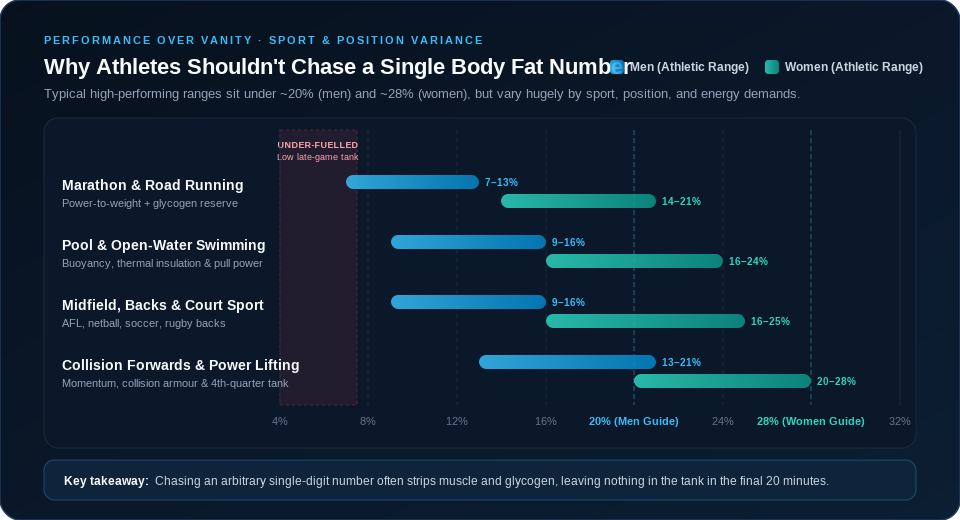
Look across the starting line-up of any AFL squad, netball team, rugby side, or open-water swim pack, and you will see wide variety in body shapes and body fat percentages. A midfielder covering 14 kilometres of high-speed running has different physical demands from a key-position forward absorbing heavy contact, and a marathon runner carries a different frame from a channel swimmer who needs buoyancy and thermal insulation in cold water.
Even within the same position, two athletes can perform at the top of their grade while sitting five percentage points apart. And as we covered in how accurate body fat estimates from a photo or scale really are, every measurement method carries a few points of wobble anyway.
As a sensible ballpark, most athletes who feel and perform well sit under roughly 20% body fat for men and under roughly 28% for women, varying by sport, position, and natural build.
Crucially, leaner is not always better. Pushing body fat down too far for your frame risks low energy availability (LEA), where the body down-regulates recovery, bone turnover, and neuromuscular output, as detailed in the 2023 International Olympic Committee consensus statement on REDs by Mountjoy and colleagues.
“The goal is never to hit the lowest number on a printout. Getting too lean leaves you with nothing in the tank to draw from when a match goes into the final twenty minutes.”
Aim for the body weight and composition range where you feel strong, recover between sessions, and perform at your best.
Body recomposition: the maths of keeping your muscle
When people try to lower their body fat percentage, they often focus on fat mass and forget total mass, including lean muscle. If you crash-diet and lose 4 kilograms of scale weight, but 2 kilograms of that loss comes from skeletal muscle in your quads, hamstrings, and upper back, your body fat percentage barely moves while your athletic power drops off a cliff.
The research on losing fat without losing muscle points to three rules:
- Keep any calorie deficit small. In a meta-analysis of 54 studies in the Scandinavian Journal of Medicine & Science in Sports, Murphy and colleagues (2021) examined resistance training in an energy deficit and found that lean mass gains were impaired once the daily deficit crept past roughly 500 kcal per day. A smaller deficit of 200 to 400 kcal/day (or losing no more than 0.5% of body weight per week, as Garthe and colleagues (2011) demonstrated in elite athletes) preserved or increased lean muscle mass and jump power compared with a fast cut.
- Keep lifting heavy and progressively. Muscle stays when your body receives a clear mechanical signal that it needs the tissue. Use strength and hypertrophy rep ranges (roughly 5 to 10 reps at 1 to 3 reps in reserve) on compound lifts twice a week so your nervous system and muscle fibres stay loaded.
- Anchor your daily protein. In a 49-study meta-analysis in the British Journal of Sports Medicine, Morton and colleagues (2018) showed that muscle protein synthesis plateaus around 1.6 g/kg/day of protein (with an upper confidence bound of 2.2 g/kg/day). Sitting toward the upper end of that range (1.8 to 2.2 g/kg/day, covered in our protein guide for strength athletes) protects your Fat-Free Mass Index (FFMI), which you can check in the calculator above.
Fuel the work: an honest take if you love food
Most nutrition advice reads as if it were written by people who treat food purely as fuel and never think about a biscuit unless it is on a spreadsheet.
I am the exact opposite. Currently, my training is built around 5/3/1 lifting in the gym and preparing to swim a 10 km marathon and immediately run a 42.2 km marathon back-to-back in under six hours, and structured exercise is what keeps me balanced because I am not naturally disciplined around the kitchen day to day.
“I am an eater—I eat when I am stressed, bored, or celebrating. Trying to starve yourself through a heavy training week always ends with a flat session at 5 pm and raiding the pantry at 8 pm. Fuelling properly around your sessions beats white-knuckling a diet every time.”
What works in practice for any time-limited athlete who enjoys food is dialling in fuelling around training sessions first:
- Pre-session carbs are non-negotiable. Go into hard runs, swims, and gym sessions fuelled so you can hit the paces and weights on the plan.
- Fuel during long sessions. Anything pushing past 75 to 90 minutes gets carbohydrate intake on the move (see our guide to fuelling during long sessions).
- Recovery drink and water straight after. Within 20 to 30 minutes of finishing a hard session, get water, electrolytes, protein, and carbohydrates in immediately. Nailing pre-, intra-, and post-session nutrition helps your body recover for tomorrow’s workout and prevents the bottomless evening hunger that derails your kitchen habits.
Time your body composition focus around your season
In team sports or endurance racing, when you shift your body composition matters as much as how you do it:
- Off-season and early pre-season: The right windows for a deliberate recomposition block, when match stress is zero and a modest deficit or higher hypertrophy volume will not cost you competition points.
- Late pre-season and in-season: Built for performance and maintenance. Once games or peak race-pace workouts begin, focus on fuelling the work, holding strength in two focused sessions a week, and keeping plenty in the tank for the final quarter.
How Pelaris connects your scan to your training plan
Our team built Pelaris so your body composition goals and your performance goals live inside the same coaching engine:
- Your program adapts to both goals. Tell Pelaris your sport, season dates, and whether you want to build lean mass, shift your shoulder-to-waist proportions, or lean out gradually. It spaces your heavy lifting and conditioning so you do not burn out.
- Range tracking without the daily panic. Take a two-photo check-in on the Body scanning tab every two to four weeks, or upload a DEXA or InBody sheet when you have one. Pelaris tracks your body fat range and 3D Body Blueprint trend alongside the workouts you logged that month.
What this means for your training
- Drop the single-number obsession. High-performing athletes generally sit under about 20% body fat for men and 28% for women, with wide variation by sport and position.
- Protect your muscle with lifting and protein. Keep two to four progressive strength sessions in your week and aim for 1.6 to 2.2 g/kg/day of protein to protect your Fat-Free Mass Index (FFMI).
- Keep deficits small and time them to the off-season. Based on the Murphy et al. (2021) meta-analysis, deficits beyond 500 kcal/day blunt muscle gains; make gradual changes in the off-season and prioritise full fuelling in-season.
- Fuel before, during, and straight after sessions. Proper carbohydrates around training protect session quality and stop post-workout binge hunger before it starts.
18–23%
Midpoint ~20% (±2.5% band)
60.4–64.3 kg
Fat mass: 13.7–17.6 kg
0.46
Below 0.50 (Ashwell adult guideline)
Sits inside the broad athletic performance window (roughly 8% to 20% for men, varying widely by sport and position).
Pelaris Body Shape Archetypes (Matched from Your Proportions)
Adjust waist, shoulders, or hips above to see how your proportions map across the 6 Pelaris 3D Blueprint builds.
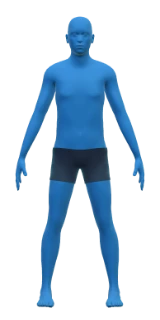
A streamlined endurance build that carries speed and distance with ease.
Runners, distance swimmers, triathletes
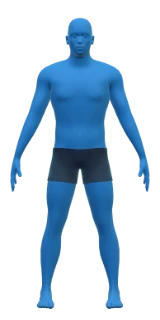
Broad shoulders over a narrow waist, the classic athletic taper.
Swimmers, gymnasts, rugby backs
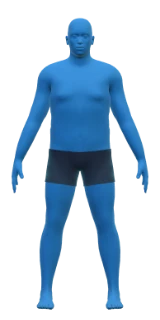
A powerful, solid frame built for moving heavy loads.
Powerlifters, strongmen, rugby forwards
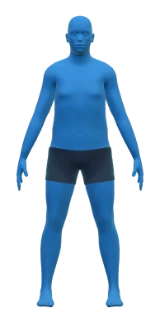
A strong lower-body engine with power through the hips and legs.
Track cyclists, sprinters, rowers
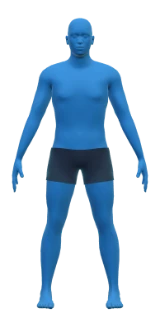
Balanced shoulders and hips around a defined waist, ready for any training style.
Functional fitness, hybrid athletes
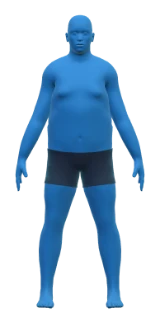
A sturdy frame with strength through the core, ready for any training style.
Heavyweight lifters, athletes in a rebuilding phase
For adults aged 18 and over. Shown as a range because every field estimate has error tolerance. Not a medical assessment.
The link carries the numbers you entered in the part of the address after the #, which is never sent to a server. Share it only with people you are happy to show those numbers to.
About these numbers: Formula, guard-rails & 3 peer-reviewed citations ▾
RFM (Male) = 64 − 20 × (Height ÷ Waist) · RFM (Female) = 76 − 20 × (Height ÷ Waist) · Range = ±2.5% to ±3.5%
Woolcott and Bergman (2018) validated Relative Fat Mass against DXA across 3,456 US adults in NHANES, finding lower total error than BMI. Even so, any field method (tape, bioimpedance scale, or AI photo scan) carries an individual error tolerance of roughly 3 to 4 percentage points. Use the same tape site and time of day, and watch how the range moves over 4 to 8 weeks rather than chasing a single number.
- • Relative Fat Mass (RFM) estimates whole-body fat percentage from height and waist circumference using a DXA-validated equation (64 minus 20 times height divided by waist for men; 76 minus 20 times height divided by waist for women). Like every tape or photo estimate, it carries an individual error band of several percentage points, so we show it as a range rather than a single number. [Source]
- • Waist-to-height ratio earns its place on your card, this review of 31 studies found it a sharper screening signal than BMI or waist alone. [Source]
- • Your waist-to-hip ratio is read against the World Health Organization's expert consultation, the global reference for what waist measurements genuinely tell us. [Source]
General fitness and training estimates only, labelled EST. Not medical advice or a clinical diagnosis.