Pre-Season Conditioning for Team Sports: MAS, Bronco & 2km
How to turn a 2km time trial or 1.2km Bronco test into Maximal Aerobic Speed (MAS) and set up 15:15 and 30:15 interval grids for AFL, rugby, soccer and netball.
On this page (5 sections)
- Why Maximal Aerobic Speed (MAS) beats “everyone run to the try line”
- Step 1: Testing your MAS (2km Time Trial vs 1.2km Bronco)
- Step 2: The 6-week pre-season MAS progression
- Three mistakes that blow up knees and hamstrings before Round 1
- What this means for your training
- ⚡ Interactive: MAS & Bronco Grid Calculator
Every November and January, club players across AFL, rugby union, rugby league, football (soccer), and netball make one of two pre-season errors. Half the squad does almost nothing over the break, turns up to week one of pre-season, and gets hit with sudden shuttle volume that blows up calves, hamstrings, or patellar tendons before round one. The other half spends eight weeks plodding along on slow road runs.
“Field and court sports are not steady-state endurance events. Plodding along on slow 8 km road runs over the break just makes you fit enough to jog all day while leaving you half a yard slower over the first ten metres.”
Games are intermittent, repeat-sprint battles where your aerobic system’s primary job is to replenish phosphocreatine (PCr) and clear metabolic byproducts between explosive efforts in 15 to 30 seconds.
This guide shows how strength and conditioning coaches build a team-sport running engine from a 2km time trial or 1,200m Bronco shuttle, convert it into Maximal Aerobic Speed (MAS), and lay out individualised 15:15 and 30:15 interval grids on the pitch.
Why Maximal Aerobic Speed (MAS) beats “everyone run to the try line”
Walk onto most club pitches during pre-season and you see the entire squad lined up on the goal line running identical 100-metre repeats on the whistle. Physiologically, that session fails two-thirds of the group:
- The aerobic midfielders and outside backs: Cruise through reps at 85 per cent effort, never spending enough time near maximal oxygen uptake (VO2max) to force central cardiovascular adaptation.
- The heavier tight-five forwards, rucks, or key defenders: Sprint at 105 per cent of anaerobic capacity from rep one just to make the line, accumulating heavy blood lactate and hamstring strain until mechanics break down on rep four.
Defined by Billat and Koralsztein (1996), MAS is the lowest running velocity at which VO2max occurs.
“When you prescribe time at a percentage of MAS instead of arbitrary 100-metre repeats, a midfielder and a tight-five prop start on the same whistle, finish on the same whistle, and experience the exact same physiological stimulus.”
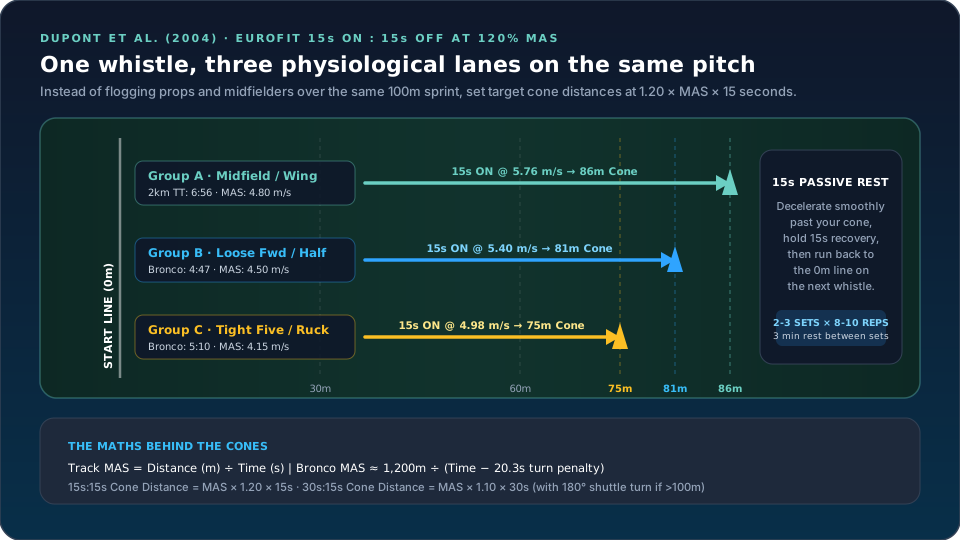
On a 15-second whistle at 120 per cent of MAS, a midfielder with a 4.80 m/s MAS runs to an 86-metre cone, while a prop with a 4.15 m/s MAS runs to a 75-metre cone.
Step 1: Testing your MAS (2km Time Trial vs 1.2km Bronco)
Any continuous maximal effort lasting roughly 4.5 to 7 minutes correlates closely with velocity at VO2max. Two field tests dominate team sports across Australia, New Zealand, the UK, and Ireland:
1. The 2km Time Trial (or 1.5km / 5-Minute Run)
Run on a flat 400m track or measured pitch perimeter without 180-degree turns, the calculation is direct:
- Formula: MAS (m/s) = Distance in metres ÷ Total time in seconds
- Example: 2,000 metres in 7 minutes and 10 seconds (430 seconds) = 2,000 ÷ 430 = 4.65 m/s (16.7 km/h, or 3:35/km pace).
If 2,000 metres takes you longer than 8 minutes, a 1,500-metre time trial or 5-minute maximal run gives a cleaner read of your true MAS, since efforts beyond 7 to 8 minutes reflect fractional threshold utilisation rather than VO2max velocity.
2. The 1.2km Bronco Test (20m - 40m - 60m Shuttles)
Standard in rugby union and rugby league, the Bronco consists of five continuous sets of a 20m shuttle (40m), 40m shuttle (80m), and 60m shuttle (120m), totalling 1,200 metres.
Because the Bronco includes 29 sharp 180-degree turns where you decelerate to zero, plant a foot, and re-accelerate, dividing 1,200m by raw Bronco time underestimates straight-line speed. To bridge shuttle times to straight-line MAS, our team at Pelaris subtracts roughly 0.7 seconds per turn (20.3 seconds across 29 turns):
- Formula: Adjusted Bronco MAS (m/s) ≈ 1,200 ÷ (Bronco Time in seconds − 20.3)
- Example: A 4:47 (287s) Bronco minus 20.3s equals 266.7s of effective running time; 1,200 ÷ 266.7 = 4.50 m/s.
Always re-test with the exact same protocol at the end of your block.
Generate your own pitch cones: Enter your 2km time trial, 1.5km run, or 1.2km Bronco time into the Maximal Aerobic Speed (MAS) & Bronco Pitch Grid Calculator to get your exact cone distances for 15s:15s, 30s:15s, and long-interval grids.
Step 2: The 6-week pre-season MAS progression
Once you have your MAS number, the goal is accumulating time at or above 100% VO2max while progressively introducing the deceleration loads your tendons face in round one.
In Dupont, Akakpo, and Berthoin (2004), adding two short interval sessions per week—including 15-second runs at 120% of MAS alternated with 15 seconds of passive rest—improved professional soccer players’ MAS by 8.1 per cent and 40-metre sprint time by 3.5 per cent while maintaining jumping power. Jens Bangsbo’s work on intermittent recovery testing and Martin Buchheit’s research on the 30-15 Intermittent Fitness Test confirmed that 15s:15s and 30s:15s blocks hold oxygen uptake near VO2max while keeping blood lactate manageable enough to preserve running mechanics.
Here is a 6-week progression using two conditioning sessions per week, spaced away from heavy lower-body gym days:
| Weeks | Primary Format | Work : Rest | Intensity (% MAS) | Example Cone Target (MAS = 4.50 m/s) | Sets & Volume | Physiological Focus |
|---|---|---|---|---|---|---|
| Weeks 1-2 | Extensive MAS / Long Intervals | 120s ON : 60s OFF (or 60s:60s) | 100% MAS | 540m per 2-min rep (or 270m per 60s) | 1-2 sets of 4-5 reps (3 min between sets) | Build stroke volume & aerobic base with low deceleration stress |
| Weeks 3-4 | Eurofit 15:15 Grid | 15s ON : 15s OFF (Passive rest) | 120% MAS | 81m straight-line cone per 15s rep | 2-3 sets of 8-10 reps (3 min between sets) | Maximise time at VO2max + high-speed running exposure |
| Weeks 5-6 | 30:15 Shuttle Grid | 30s ON : 15s OFF (Passive rest) | 110% MAS (with 1 shuttle turn) | 148.5m total (e.g. 74m out & back) | 2 sets of 6-8 reps (4 min between sets) | Combine high aerobic demand with eccentric braking & re-acceleration |
Three mistakes that blow up knees and hamstrings before Round 1
- Stacking heavy squats and 120% MAS runs in the same 12 hours. As covered in adaptive plans vs fixed periodization, eccentric running forces compete with lower-body strength recovery (Wilson et al., 2012). Keep at least a 6-hour gap on the same day, and ideally 48 hours between heavy lower-body lifting and fast MAS runs.
- Jumping from zero shuttles to 30+ hard decelerations. Build straight-line capacity in Weeks 1 and 2 before layering in 180-degree turns across Weeks 3 to 6.
- Ignoring multi-week fatigue when club sessions ramp up. Watch your 14-day soreness and RPE trends (see why AI coaches struggle with fatigue), trim a set when match simulations run long, and transition into an MD-4 / MD-2 match-week rhythm using our in-season training for team sports guide once fixtures begin.
What this means for your training
- Test, do not guess. Anchor interval distances with a 2km time trial, 1.5km run, or 1,200m Bronco shuttle.
- Account for shuttle turns on the Bronco. Subtract 20.3 seconds before dividing into 1,200 metres so straight-line MAS cones are fast enough.
- Use 15s:15s at 120% MAS to build repeat-effort speed without slow road plodding.
- Progress from straight lines to shuttles across six weeks to protect calves, hamstrings, and tendons.
- Coordinate gym and pitch load. Set cones with the MAS & Bronco Grid Calculator and schedule strength and conditioning together in Pelaris.
4.37 m/s
3:49/km pace
79 m
Dupont 15:15 grid
Club Range
Pelaris guide ranges
| Conditioning Protocol | Target Cone Distance | Set & Rep Prescription |
|---|---|---|
| 15s ON : 15s OFF (120% MAS) | 79 m | 2 sets × 8–10 reps (3 min rest between sets) |
| 30s ON : 15s OFF Shuttle (110% MAS) | 141 m | 2 sets × 6–8 reps (with 1 shuttle turn) |
| 2-Min Aerobic Cruise (100% MAS) | 524 m | 4 to 5 reps × 2 min ON : 90s walk recovery |
| 10s Supramaximal ASR (130% MAS) | 57 m | 1 set × 6–8 reps : 50s passive recovery |
General fitness and training estimates only. Not medical advice.
The link carries the numbers you entered in the part of the address after the #, which is never sent to a server. Share it only with people you are happy to show those numbers to.
About these numbers: Formula, guard-rails & 3 peer-reviewed citations ▾
MAS (Track) = Distance (m) ÷ Time (s) · MAS (Bronco) ≈ 1200 ÷ (Time − 20.3s) · 15:15 = 1.20 × MAS × 15s
The Bronco has 29 turns of 180 degrees. Pelaris assumes about 0.7 seconds is lost at each turn (an assumption, not a published constant), so about 20 seconds comes off your time before speed is worked out. The squad reference ranges are also Pelaris rules of thumb. Treat results as a planning estimate and retest the same way each block.
- • In professional soccer players, in-season interval work that included 15-second runs at 120 per cent of Maximal Aerobic Speed (MAS) with 15 seconds of rest improved MAS and sprint times, which is the basis for setting interval distances as a percentage of MAS. [Source]
- • The Yo-Yo intermittent recovery test measures the ability to repeat intense exercise with short recoveries, which is why it is used to evaluate fitness in intermittent sports. [Source]
- • How your loads, sets and rest periods step up across a training block follows the American College of Sports Medicine's progression model for healthy adults. [Source]
General fitness and training estimates only, labelled EST. Not medical advice or a clinical diagnosis.