CrossFit Training
Strength. Engine. Skill.
Programmed together.
Affiliate programming serves the class. Yours should serve you, your weaknesses, your competition calendar, the strength numbers you are chasing. Pelaris builds CrossFit programs that match the athlete you want to be.
4-6
Sessions per week
5
Energy systems trained
12+
Skill lifts tracked
RPE
Auto-adjusts next session
Programme & Log Audit · Schoenfeld Volume Landmarks
Interactive Workout Split Analyser & 1RM Calculator
Audit your weekly movement patterns for push:pull symmetry and project 1RMs with RIR adjustments.
50 sets
Schoenfeld Target: 10-20/muscle
1.5 : 1
Target symmetry: 1.0 : 1
1.5 : 1
Posterior chain balance
- • Push-to-Pull ratio is 1.5:1. Add 6 weekly upper-back/row sets to balance shoulder mechanics.
- • Quad-to-Posterior ratio is 1.5:1. Add 3 to 4 hinge/hamstring sets (RDLs or Nordic curls).
- • One cardio session or fewer a week is unlikely to reach the WHO 150 to 300 minutes of moderate activity. If you can, add one or two easy Zone 2 sessions, ideally 6 hours away from lifting.
General fitness and training estimates only. Not medical advice.
The link carries the numbers you entered in the part of the address after the #, which is never sent to a server. Share it only with people you are happy to show those numbers to.
About these numbers: Formula, guard-rails & 3 peer-reviewed citations ▾
Target Hypertrophy Band = 10–20 Hard Sets/Muscle/Week · Optimal Push:Pull ≈ 1.0 : 1.0
All CSV parsing and volume calculations run 100% locally in your browser. Warm-up sets (RPE < 6 or > 4 RIR) should not be counted toward your 10 to 20 weekly working sets.
- • More quality sets generally means more muscle, and this meta-analysis is why your weekly volume grows deliberately rather than all at once. [Source]
- • How your loads, sets and rest periods step up across a training block follows the American College of Sports Medicine's progression model for healthy adults. [Source]
- • The weekly movement target your plan aims at, 150 to 300 minutes of moderate activity plus regular strength work, comes straight from the WHO's global guidelines. [Source]
General fitness and training estimates only, labelled EST. Not medical advice or a clinical diagnosis.
Leave this at 0 RIR and the number is plain Epley on the reps you completed, the same as the Pelaris app shows for the same set. If you stopped short of failure, choose the reps you had left and they are added to the set.
116.7 kg
Epley · 5 effective reps
94.5 kg
Strength-Hypertrophy
87.5 kg
Hypertrophy Working Load
| Reps | % 1RM | 0 RIR Max | Target @ 2 RIR | Training Zone |
|---|---|---|---|---|
| 1RM | 100% | 116.5 kg | 106 kg | Max Strength |
| 2RM | 94% | 109.5 kg | 103 kg | Max Strength |
| 3RM | 91% | 106 kg | 100 kg | Max Strength |
| 5RM | 86% | 100 kg | 94.5 kg | Strength-Hypertrophy |
| 6RM | 83% | 97 kg | 92 kg | Hypertrophy |
| 8RM | 79% | 92 kg | 87.5 kg | Hypertrophy |
| 10RM | 75% | 87.5 kg | 83.5 kg | Hypertrophy |
| 12RM | 71% | 83.5 kg | 79.5 kg | Hypertrophy |
| 15RM | 67% | 78 kg | 74.5 kg | Muscular Endurance |
General fitness and training estimates only. Not medical advice.
The link carries the numbers you entered in the part of the address after the #, which is never sent to a server. Share it only with people you are happy to show those numbers to.
About these numbers: Formula, guard-rails & 3 peer-reviewed citations ▾
1RM = Weight × (1 + Reps ÷ 30) · optional: add Reps in Reserve to Reps
Reynolds, Gordon and Robergs (2006) concluded that a one-rep max can be estimated well from multiple-repetition sets, and advised staying at or under about ten repetitions. Past that, the result is a rough guide because the set measures endurance and discomfort tolerance as much as maximal strength.
- • Your projected 1RM is read off a hard multi-rep set, and this study is the evidence that a max can be estimated well without you ever having to test one. [Source]
- • Reps in reserve is how we ask you to rate a set, a scale built so your effort on the day sets the load rather than a fixed number on paper. [Source]
- • How your loads, sets and rest periods step up across a training block follows the American College of Sports Medicine's progression model for healthy adults. [Source]
General fitness and training estimates only, labelled EST. Not medical advice or a clinical diagnosis.
The four pillars
Every CrossFit program, balanced
The failure mode of affiliate programming is accidental bias, a week of skill-heavy sessions, then a week of pure metcons, then a deload that breaks nothing. Pelaris keeps the four pillars balanced week-on-week.
Strength foundation
Heavy singles, 3-rep maxes, technique work on the Olympic lifts. CrossFit rewards a big base. Pelaris builds strength on dedicated days, not buried inside a metcon, so progress is measurable and recoverable.
Engine capacity
Row, bike, run, ski, aerobic and glycolytic systems both matter. Pelaris programs interval work across all four modes with progressive load and clear purpose: threshold, repeat 1-min, sprint recovery.
Metabolic conditioning
The classic metcons. Pelaris builds them with intent, skill practice at pace, sustained pace pieces, and a small number of grinders. The balance between "test" and "build" that most affiliates get wrong.
Skill practice
Double-unders, muscle-ups, handstand walks, bar muscle-ups, ring skills. Pelaris front-loads skill work when you are fresh and schedules enough repetition for neural patterns to stick.
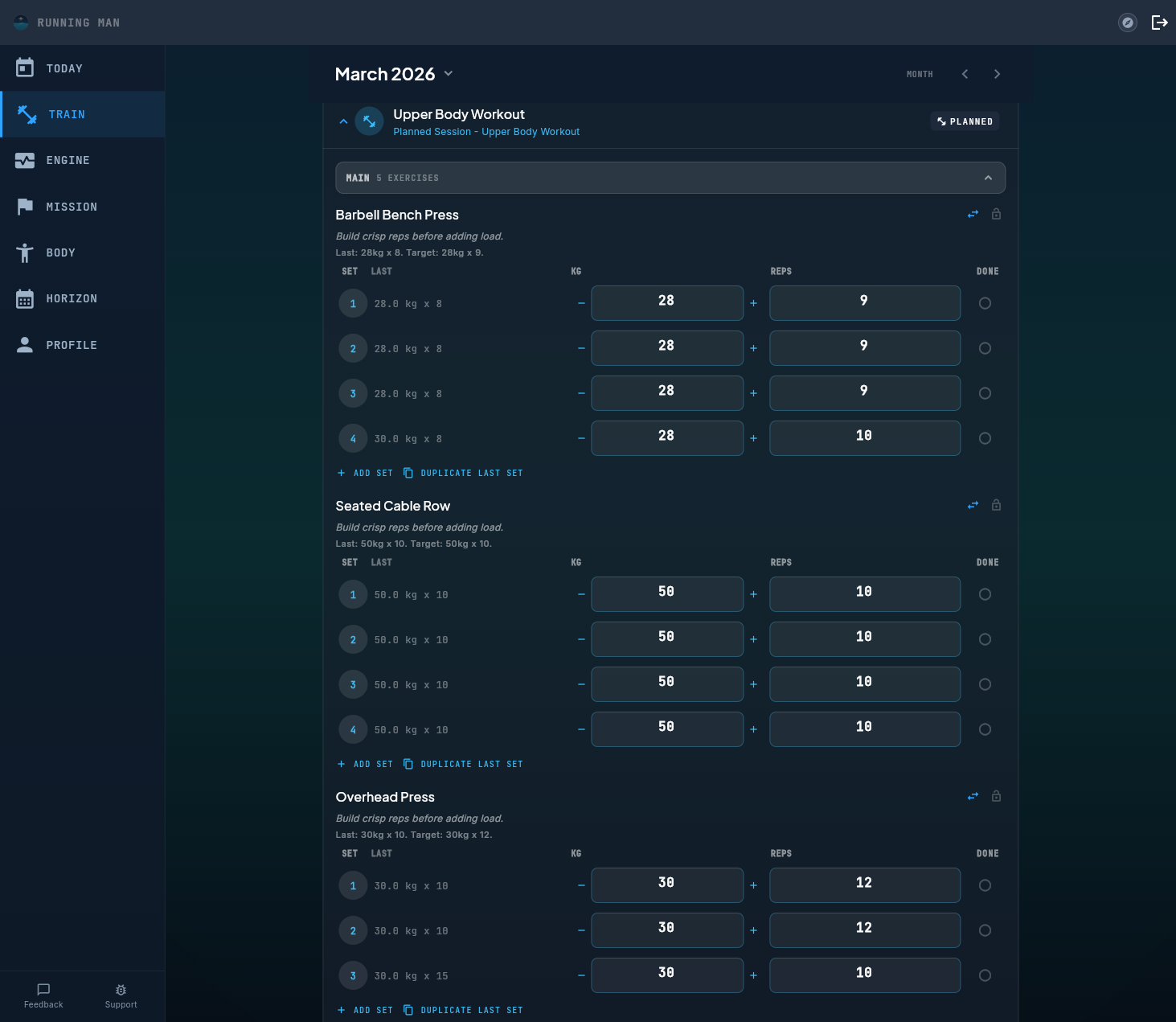
Track every format
Log the workout the way it was written
Strength sets at a prescribed percentage. AMRAP round + rep splits. EMOM completion check-ins. For Time with splits per round. Pelaris tracks them natively, no retro-fitting your workout into a generic tracker.
PR detection fires automatically on weight and rep-count records. Every set feeds back into the program so your next front squat day calibrates to the load you actually moved, not the one prescribed three weeks ago.
See all tracking featuresAthlete profiles
Built for the athlete you already are
Competitor
Training 6 days a week. Two-a-days in-season. Programmed around upcoming events (Open, Quarterfinals, Semis). Skill-weighted with olympic lifting specificity.
Enthusiast
4-5 days a week, wants to be strong, conditioned, and skilled but has a life outside the gym. Balanced program with protected recovery. No accumulation phases that break you for deload weeks.
Returning lifter
Strength background, wants the conditioning that CrossFit gives without losing the numbers. Pelaris weights the strength block while building the engine from a low-load base.
Hybrid athlete
Also running, also lifting, also playing a sport. Pelaris coordinates all of it, CrossFit sessions become one pillar in a larger program, not the whole program.
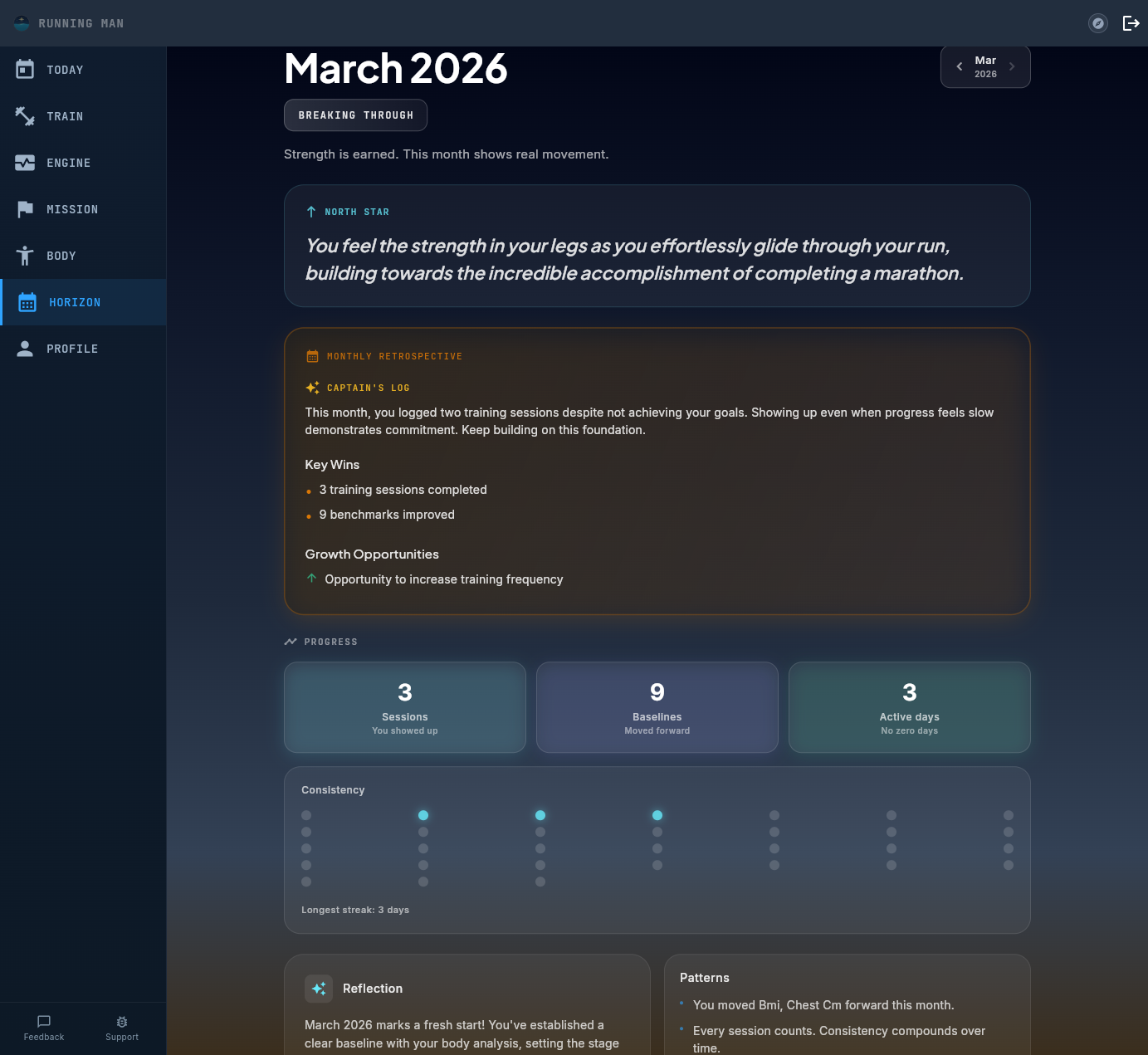
See the shape of your month
Strength days, metcon days, skill sessions, recovery, laid out so you can see the periodisation before you live it.
Questions
CrossFit training, answered
Is Pelaris a CrossFit programming app? +
How does Pelaris avoid overtraining? +
Can I track CrossFit-style workouts (AMRAP, EMOM, For Time)? +
I do CrossFit but want to train for a half-marathon, can Pelaris handle that? +
How does Pelaris handle Open / Quarterfinals prep? +
Is it compatible with my box programming? +
Stop guessing. Start training with intent.
Describe what you want to be good at. Pelaris builds the program that gets you there.