Endurance training
Endurance training for every event.
Open water, road, trail, triathlon.
Pelaris programs endurance training across open-water swimming, marathon and ultra running, triathlon, swimrun, and cycling events. Periodised on named methodologies, adapted to your event date, your weekly hours, and your logged fatigue. Free tracking sits underneath.
Interactive VO2max, VDOT & Race Time Calculators
Interactive VO2max & Fitness Age Calculator
44.5 mL/kg
Daniels-Gilbert VDOT
58th %ile
FRIEND Registry Cohort
31 yrs
3 yrs younger than your age
| Daniels Training Zone | Target Pace (/km) | Physiological Purpose |
|---|---|---|
| Easy / Zone 2 | 5:22 - 5:57/km | Aerobic base, capillary density & mitochondrial volume |
| Marathon Pace | 4:57 - 5:09/km | Specific aerobic durability & glycogen economy |
| Lactate Threshold (T) | 4:40 - 4:48/km | Raise lactate clearance ceiling (20 to 40 min efforts) |
| VO2max Interval (I) | 4:13 - 4:21/km | Maximal oxygen uptake (3 to 5 min repeats) |
| Repetition (R) | 3:54 - 4:03/km | Running economy & neuromuscular speed (200m to 400m) |
A field estimate for motivation, not a medical assessment. Lab testing is the clinical reference.
The link carries the numbers you entered in the part of the address after the #, which is never sent to a server. Share it only with people you are happy to show those numbers to.
About these numbers: Formula, guard-rails & 3 peer-reviewed citations ▾
VO₂(v) = −4.6 + 0.182258v + 0.000104v² · %VO₂max(t) = 0.8 + 0.1894e^(−0.0128t) + 0.2990e^(−0.1933t)
Requires a hard running effort of at least 1,500 metres and 3 minutes. Lab cardiopulmonary exercise testing (CPET) remains the clinical reference; a field estimate can sit several points either side of it. Fitness age and percentile are for motivation, not a medical assessment.
- • Your VO2max estimate from a hard run comes straight from Daniels' VDOT tables, the pace-to-fitness model coaches have trusted for over forty years. [Source]
- • The "fitter than X% of people your age" line is read off real reference standards built from thousands of lab-tested adults, so your percentile actually means something. [Source]
- • Fitness age is the idea that your VO2max can sit younger or older than your birthday suggests, first mapped across 4,637 adults in Norway's HUNT study. [Source]
General fitness and training estimates only, labelled EST. Not medical advice or a clinical diagnosis.
46:55
4:42/km
1:43:30
4:54/km
3:35:48
5:07/km
| Distance | Projected [EST] | Pace / km | Pace / mi | Pelaris 0.5x–2.0x Fence |
|---|---|---|---|---|
| 1,500m | 6:17 | 4:11/km | 6:44/mi | Outside 0.5x Fence (0.30x distance) |
| 1 Mile | 6:46 | 4:12/km | 6:46/mi | Outside 0.5x Fence (0.32x distance) |
| 3K | 13:06 | 4:22/km | 7:02/mi | Supported Projection (0.5x to 2.0x) |
| 5K | 22:30 | 4:30/km | 7:15/mi | Known Effort Baseline |
| 10K | 46:55 | 4:42/km | 7:33/mi | Supported Projection (0.5x to 2.0x) |
| 15K | 1:12:06 | 4:48/km | 7:44/mi | Outside 2.0x Fence (3.0x distance) |
| Half Marathon (21.1K) | 1:43:30 | 4:54/km | 7:54/mi | Outside 2.0x Fence (4.2x distance) |
| Marathon (42.2K) | 3:35:48 | 5:07/km | 8:14/mi | Outside 2.0x Fence (8.4x distance) |
General fitness and training estimates only. Not medical advice.
The link carries the numbers you entered in the part of the address after the #, which is never sent to a server. Share it only with people you are happy to show those numbers to.
About these numbers: Formula, guard-rails & 2 peer-reviewed citations ▾
T₂ = T₁ × (D₂ ÷ D₁)^1.06 · Supported Fence: 0.5× ≤ D₂/D₁ ≤ 2.0×
Pelaris only auto-projects race times between half and double the distance you actually ran (for example, 5K to 3K or 10K). Distances beyond 2.0x require specific long-run durability and fuelling verification.
- • When a strong run at one distance hints at your time over another, that is Riegel's power law, drawn from world records from 100 metres out to 100 miles. [Source]
- • Your VO2max estimate from a hard run comes straight from Daniels' VDOT tables, the pace-to-fitness model coaches have trusted for over forty years. [Source]
General fitness and training estimates only, labelled EST. Not medical advice or a clinical diagnosis.
The four disciplines
One endurance engine, four expressions of it
Aerobic capacity is the shared foundation. How it gets expressed in the water, on the road, or on a bike changes the volume math and the session shapes. Pelaris knows the difference, and periodises each discipline against its own demand curve.
Open water swimming
From your first 5km crossing to 15km channel swims. Pelaris programs pool and open-water sessions around your event date, with pacing, sighting drills, and cold-water acclimatisation scheduled alongside strength and recovery.
Marathon and ultra
Beginner marathons through 100km ultras. Periodised base, build, peak, taper on named methodology (Pfitzinger, Hansons, Daniels, 80/20, Lydiard). Long-run progressions respect cumulative fatigue, not a static weekly template.
Multisport
Triathlon, swimrun, aquathlon, aquabike. Three-sport periodisation that sequences swim, bike and run sessions so interference is minimised and brick work lands at the right phase of the block.
Cycling endurance
Century rides, gran fondos, ultra-cycling events. Zone-based programming on a chosen methodology (Sweet Spot, Polarised, Coggan, Traditional Base) with FTP-driven intensity scheduling and event-day fueling prep.
Events supported
From your first 5k to a channel crossing
Every event type below has a dedicated training hub. Pelaris reads your event date at intake and works backwards, so a beginner marathon and a sub-2:50 build use the same methodology library with different volumes, paces, and peak weeks.
Open water swim
5km, 10km, 15km channel, Rottnest, Cole Classic, English Channel
Swimming training hubMarathon + ultra
First marathon, sub-3:00, sub-4:00, 50k, 50-mile, 100k, 100-mile
Marathon training hubCycling endurance
100km sportive, gran fondo, audax, 24-hour events, multi-day tours
Cycling training hubPlan the block, hit the event
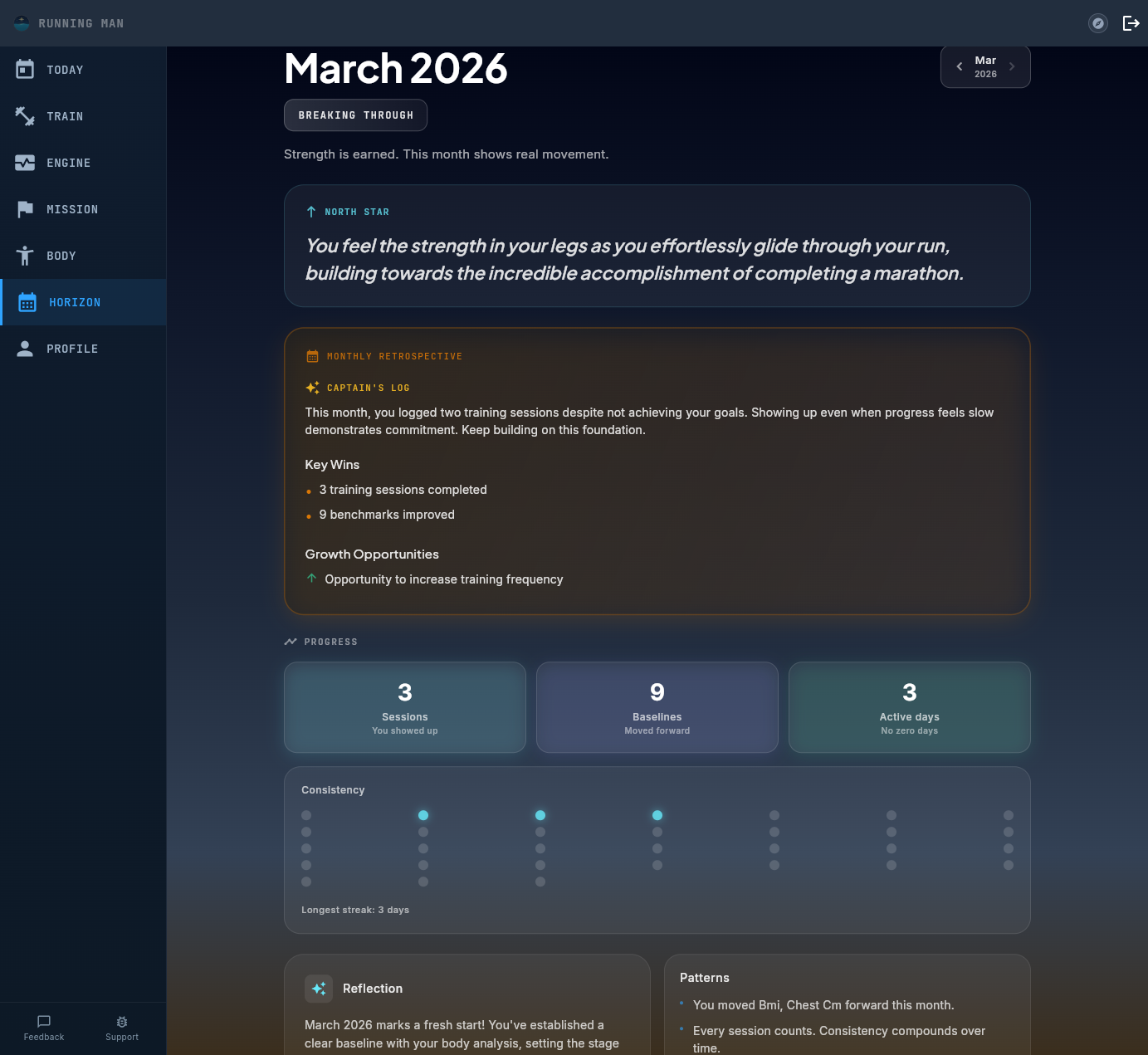
Horizon shows base, build, specific and taper for the full 16-20 week endurance arc. Weekly hours climb, then retreat. Race day sits as the peak, not the end.
Periodisation
An 18-week arc, phase by phase
The arc scales: a first 10km is six weeks, a first marathon is 16, an Ironman build is 24-28. Same four phases, different lengths, methodology-appropriate volumes throughout.
Base
Aerobic base building. Easy-pace volume, technique work, and the unglamorous foundation every serious endurance block rests on. Pelaris defaults most of your weekly hours here because the adaptation window for aerobic capacity is wide and the work is recoverable.
Build
Threshold and sub-threshold work layered on the aerobic base. Long runs, open-water endurance sets, sweet-spot intervals on the bike. The volume stays high; intensity climbs carefully.
Specific
Race-pace work, brick sessions, course-specific simulation. For open-water swimmers this is where cold acclimatisation lands. For marathoners this is the dress-rehearsal long run at goal pace. For triathletes, the full race-simulation brick.
Taper
Volume drops 40-50 percent over 10-14 days, intensity maintained. Sleep targets rise, nutrition locks in, race-day logistics rehearse. Fresh body, sharp head, no new stimulus.
Questions
Endurance training, answered
Does Pelaris program for open water swimming specifically? +
What marathon methodology does Pelaris use? +
Can I train for an ultra while keeping a full life? +
How does Pelaris handle triathlon interference? +
Is the free tier enough for endurance training? +
What about short-course racing, 5k and 10k? +
Do you handle cold-water swimming and channel crossings? +
Commit to an event. Let Pelaris write the block.
Marathon in six months, Rottnest in twelve, first triathlon in eighteen. Tell the app; it writes the 16-28 week arc.