training · general
Plyometric training for athletes: how to train like the pros, prevent injury, and unlock explosive performance
95 contacts
Davies et al. (2015)
1:5 to 1:10
90 to 120s between sets
48 to 72h
Perform before heavy lifts
| Recommended Drill | Sets × Reps | Coaching Cue |
|---|---|---|
| Single-Leg Snap-Down to Stick | 3 × 6 | Deceleration & knee alignment |
| Countermovement Box Jump (Step Down) | 4 × 5 | Concentric impulse without landing tax |
| Lateral Skater Bounds to Stick | 3 × 6 | Frontal-plane ankle & hip stiffness |
General fitness and training estimates only. Not medical advice.
The link carries the numbers you entered in the part of the address after the #, which is never sent to a server. Share it only with people you are happy to show those numbers to.
About these numbers: Formula, guard-rails & 2 peer-reviewed citations ▾
Starting budget: Beginner ≈ 65 contacts · Intermediate ≈ 95 · Advanced ≈ 125 (×0.6 In-Season) · Rest 1:5–1:10
Do your most explosive plyometrics early in a session, before heavy squats or conditioning, and leave about 48 to 72 hours between plyometric days. Davies et al. (2015) describe the best gap as not yet settled, so build up gradually and back off if your knees or Achilles complain.
- • This clinical commentary describes counting ground contacts per plyometric session, building them up gradually with experience, and leaving about 48 to 72 hours between plyometric sessions. It is a practical guide, and the authors note the best dose is not settled. [Source]
- • How your loads, sets and rest periods step up across a training block follows the American College of Sports Medicine's progression model for healthy adults. [Source]
General fitness and training estimates only, labelled EST. Not medical advice or a clinical diagnosis.
If you have ever watched an EPL winger explode past a defender, an NFL receiver high-point a contested ball, an NBA forward rise for a putback dunk, or a tennis pro change direction mid-rally and recover the next ball, you have watched plyometrics in action.
Plyometric training, sometimes called “jump training” or just “plyos,” is the bridge between the weight room and the field. It is how strong athletes become explosive athletes. And contrary to the Instagram clips of monster box jumps, plyometrics work for every level of athlete. Done correctly, they make you faster, more powerful, and more resilient to injury.
This guide answers the questions athletes most often ask about plyometric training: what it actually is, how the pros use it, how it prevents injuries, how to do it safely, and how to program it for your sport.
What are plyometric exercises, really?
Plyometrics are explosive movements that train your muscles and tendons to produce maximum force in the shortest possible time. The mechanism is the stretch-shortening cycle (SSC), a rapid sequence where a muscle is loaded eccentrically (lengthened under tension), then immediately contracts concentrically (shortens) to produce force.
Think about jumping. If you stand still and try to jump straight up from a static position, you don’t get very high. But if you quickly dip into a quarter squat first and rebound out of it, you jump significantly higher. That dip-and-rebound is the SSC. It stores elastic energy in your tendons and triggers a stretch reflex in the muscle, releasing far more force than a concentric contraction alone.
Plyometric exercises are designed to train this cycle deliberately. The shorter the time between landing and exploding (the “amortization phase”), the greater the plyometric effect. Elite coaches aim for ground contact times under 0.2 seconds for true plyometric work.
The training adaptations are largely neural rather than muscular. Plyometrics teach your nervous system to recruit existing muscle fibres faster and more synchronously. That is why plyometric training improves performance in the first 6 to 8 weeks before any visible change in muscle size, and why it produces such outsized improvements in speed, agility, and power for the time invested.
Why top athletes in every major sport train this way
Plyometric training started with Soviet track and field coach Yuri Verkhoshansky in the 1960s, who called it “shock training.” It was adopted first by American track athletes, then football, basketball, and tennis. Today, every serious professional sports program on the planet builds plyometrics into the off-season and in-season blocks.
NFL: power off the line
In the NFL, the difference between making the roster and getting cut is often measured in tenths of a second over 10 yards. Plyometric box jumps, broad jumps, and bounding are staples of every NFL strength and conditioning program. The famous “60-inch box jump” footage from former Carolina Panthers linebacker Luke Kuechly went viral for a reason: that kind of vertical power is what separates elite linebackers from average ones. Saquon Barkley’s signature explosive cuts and change of direction, the kind that leaves defenders grasping at air, are a direct product of years of plyometric work, especially single-leg bounding and lateral jumps. Whether you are playing American football or AFL, the requirements are similar: explode, change direction, repeat for four quarters.
EPL and football: the first two yards are in your hips
The first two yards of a sprint, a sudden change of direction to evade a defender, the leap to win an aerial header. Every one of these is a plyometric expression. Top EPL clubs like Manchester City, Liverpool, and Arsenal all use plyometric drills in their pre-season blocks: depth jumps, lateral bounds, hurdle hops, and medicine ball throws. Erling Haaland’s terrifying acceleration and Kylian Mbappé’s first-step quickness are products of years of dedicated plyometric work. The same principles apply whether you play football (soccer), rugby, rugby league, or Gaelic football.
NBA: vertical leap is currency
In basketball, vertical leap is currency. It is the difference between a blocked shot and a poster, between a secured rebound and a possession lost. Plyometric training is foundational to every NBA development program. Ja Morant’s hang time, LeBron James’s chase-down blocks, and Victor Wembanyama’s terrifying vertical reach are all built on a base of squat jumps, depth jumps, and reactive bounding. NBA strength coaches typically program plyometrics 2 to 3 times per week in the off-season, with explicit emphasis on landing mechanics to protect ankles, knees, and ACLs over a long career.
Tennis: the split step is a plyometric
Tennis players might be the most under-recognised plyometric athletes. Every single point begins with a split-step, a small two-footed hop that pre-loads the legs the instant before the opponent makes contact with the ball. That split-step is a plyometric action. Novak Djokovic’s lateral movement, Carlos Alcaraz’s drop-shot recovery, and Iga Świątek’s ability to change direction at full sprint are all products of low-intensity, high-frequency plyometric training combined with rotational power work like medicine ball throws. Research on elite tennis players has shown that upper-body plyometric work also significantly increases serve velocity, so plyos help you both reach the ball and hit it harder.
Cricket, hockey, netball, baseball
The same principles apply across team sports. Plyometric training improves the explosive sprints, rotational power, and change-of-direction speed that determine outcomes in cricket, hockey, netball, and baseball. Cricket fast bowlers use plyometric loading to generate ball speed. Baseball pitchers use medicine ball throws to drive throwing velocity. Netball players rely on reactive jumps and lateral bounds to contest passes and rebounds.
What are the benefits of plyometric training?
Plyometric training is one of the most efficient training interventions in sports science. The published research is consistent across decades and dozens of sports.
Explosive power and speed. Plyometric training improves vertical jump, broad jump, sprint times (especially in the 10 to 40 metre acceleration phase), and rate of force development. These improvements typically appear within 6 to 8 weeks of consistent training.
Improved running economy. Distance runners who add plyometrics see meaningful improvements in running economy and 5k/10k times, because tendons store and release energy more efficiently with every stride.
Better change of direction. Plyometrics teach your nervous system to absorb force and redirect it quickly, which translates directly to agility, cuts, and lateral movement.
Increased bone density and tendon stiffness. The high-impact loading stimulates bone remodelling and strengthens connective tissue, which matters for both performance and long-term joint health.
Sport-specific power. Whether you are swinging a tennis racket, throwing a cricket ball, jumping for a header, or driving off the line in football, plyometrics develop the rapid force production that translates directly to the explosive moments that decide games.
How plyometric training prevents injury
This is the benefit most athletes don’t realise until they have experienced an injury, and it is arguably the most important.
The evidence base for plyometric training as injury prevention is now strong enough to be considered Level A. A systematic review of cluster-randomised trials confirmed that injury-prevention programs that include plyometric exercises significantly reduce non-contact ACL injuries. Meta-analyses have reported risk reductions of 52% to 85% for ACL injuries when neuromuscular training programs (which include plyometrics, balance, and strengthening) are implemented consistently.
The mechanism is straightforward. Most non-contact ACL injuries happen during landing, cutting, or deceleration, moments where the knee experiences high valgus (inward collapse) torque under poor neuromuscular control. Plyometric training directly trains the body to:
- Land softly, with knees tracking over toes rather than collapsing inward
- Absorb force through the hip and ankle rather than dumping it into the knee
- Activate the hamstrings reflexively to protect the ACL
- Maintain symmetric loading between left and right legs
- React to unpredictable stimuli with controlled, balanced movement
The Hewett study from 1999 was the watershed. Female high school soccer, basketball, and volleyball athletes who completed six weeks of plyometric neuromuscular training had a roughly 3.6× lower incidence of knee injury compared to untrained athletes. This finding became the foundation of programs like FIFA 11+, PEP, and Sportsmetrics, all of which are built around plyometric and neuromuscular components.
For athletes returning from injury, particularly ACL reconstruction, plyometrics are now considered an essential phase of rehabilitation. They restore the neuromuscular performance, movement quality, and confidence required to safely return to sport.
The takeaway: if you play a sport that involves landing, cutting, or sprinting, and you don’t include plyometrics in your training, you are leaving injury resilience on the table.
How often should you do plyometric training?
This is one of the most-asked questions, and the answer is “less than you think.”
For most athletes, 2 to 3 plyometric sessions per week is the sweet spot. Plyometric training places significant demand on the nervous system, tendons, and connective tissue. Recovery typically takes 48 to 72 hours between sessions for the same movement pattern.
A few principles to follow:
Quality over quantity. Plyometrics are about maximum effort per rep, not high volume. A typical session contains 3 to 6 sets of 2 to 5 repetitions for high-intensity work. Total ground contacts should generally stay between 80 and 120 per session for lower-body work, and significantly less if intensity is high (depth jumps, drop jumps, and similar).
Do them when you are fresh. Plyometrics belong at the beginning of a training session, after warm-up, before strength work or conditioning. Doing them fatigued is how you reinforce poor mechanics and get hurt.
Progress gradually. The standard progression is: bilateral to unilateral, low intensity to high intensity, in-place to with displacement, simple to complex. A beginner should spend weeks learning to land softly from a low box before attempting depth jumps from a 24-inch platform.
Match to your training cycle. During pre-season, plyometric volume can be higher (3 sessions per week, building movement quality). In-season, it drops to 1 to 2 maintenance sessions to preserve power without adding load to an already busy schedule.
Beginner plyometric exercises (start here)
If you are new to plyometric training, don’t start with box jumps. Start with landing mechanics. Every advanced jump is built on the ability to land softly and symmetrically.
1. Drop squat. Stand tall with feet hip-width apart, then quickly drop into a quarter-squat athletic stance. Land softly, knees over toes, weight balanced. This teaches deceleration without any jumping at all. Do 3 sets of 8 reps.
2. Pogo jumps. Small, repeated two-footed jumps in place, focusing on quick ground contact and landing on the balls of the feet. This develops ankle stiffness and rhythm. 3 sets of 15 to 20 reps.
3. Lateral bounds (skater jumps). Jump sideways from one foot to the other, sticking the landing for a beat before rebounding. Builds single-leg control and lateral power. 3 sets of 6 reps each side.
4. Broad jumps. Two-footed horizontal jump for maximum distance, focusing on a controlled, balanced landing. This is the foundation for sprint power. 3 sets of 4 reps.
5. Box step-ups with knee drive. Step onto a low box driving the opposite knee up explosively. A non-jumping introduction to single-leg power. 3 sets of 6 reps each side.
Master these for 4 to 6 weeks before progressing to box jumps, depth jumps, and bounding. Land softly. If your jumps sound like a thud, you are not absorbing force properly.
Intermediate and advanced plyometric exercises
Once landing mechanics are solid and you can comfortably handle 4 weeks of beginner work, you can progress.
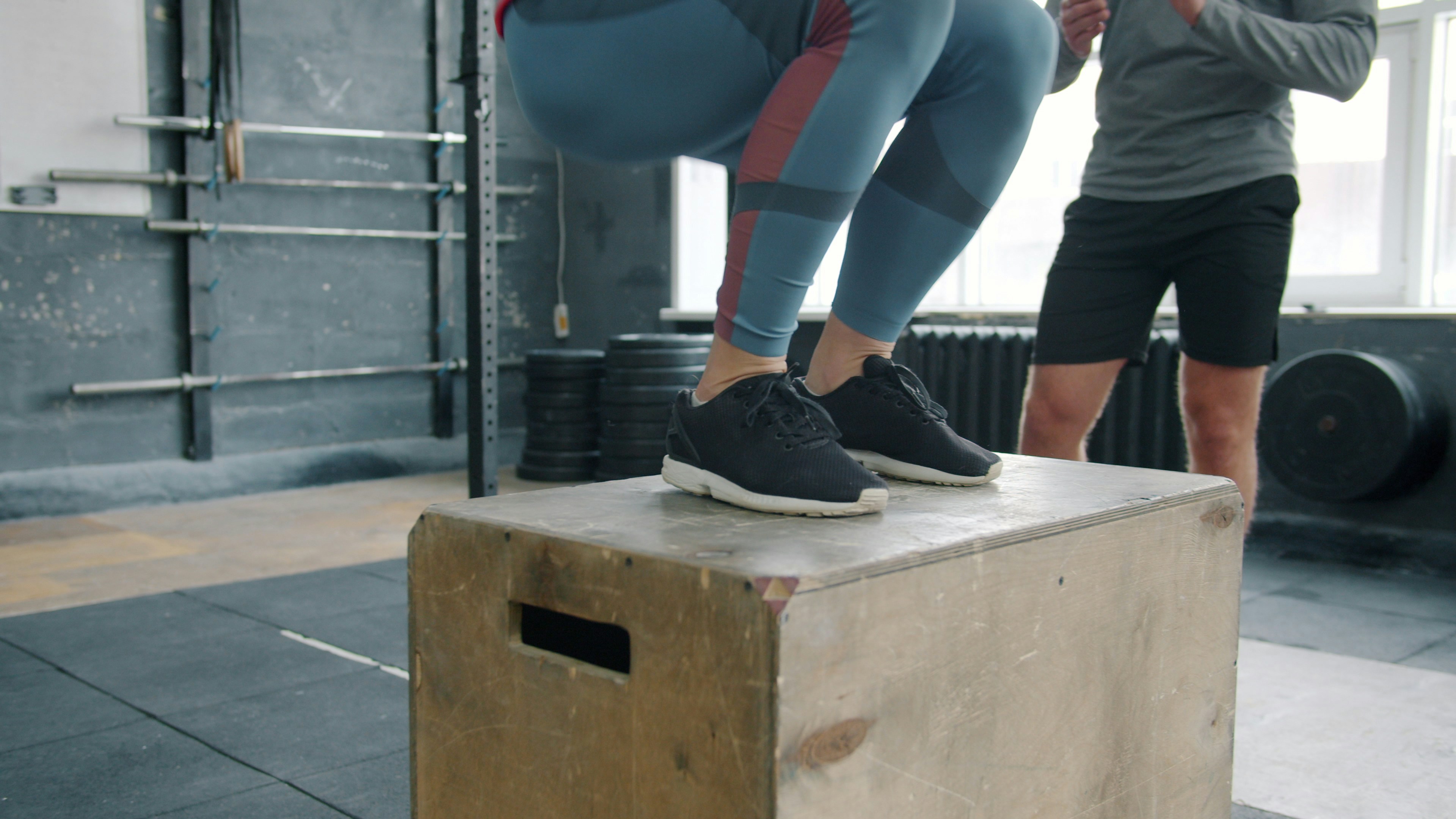
Box jumps train vertical power. Focus on the explosive jump up rather than the height of the box, and step down rather than jumping down to protect your knees on the descent.
Depth jumps are the classic Verkhoshansky shock-training exercise. Step off a 12 to 24 inch box and, the instant your feet touch the ground, explode straight up. This trains the stretch-shortening cycle at its most extreme, with ground contact times measured in tenths of a second.
Hurdle hops train repeated explosive efforts. Jump over a series of low hurdles with minimum ground contact between each.
Bounding is exaggerated running for maximum stride length and air time. Brilliant for sprint mechanics.
Single-leg jumps and hops are non-negotiable for any sport played on one leg at a time, which is most of them. Sports like football (soccer), rugby, and hockey demand single-leg power, balance, and resilience.
Medicine ball throws are the upper-body equivalent of jumping. Chest passes, slams, rotational throws, and overhead throws build power for throwing, swinging, hitting, and tackling. Essential for cricket, baseball, and any racket sport.
How long until you see results from plyometric training?
Most athletes see measurable improvements in vertical jump, sprint times, and change-of-direction performance within 6 to 8 weeks of consistent plyometric training. The early gains are almost entirely neural. Your nervous system gets better at recruiting muscle fibres rapidly and synchronously. Structural adaptations like tendon stiffness and fast-twitch fibre development come later, typically over 12 to 18 weeks.
This is faster than most strength-training adaptations, which is why plyometrics are so attractive for in-season athletes who need to peak quickly without major changes in body composition.
Common plyometric training mistakes
Too much, too soon. The most common mistake. Athletes see Instagram clips of depth jumps off 30-inch boxes and try to replicate them in week one. Plyometrics are like medicine: minimum effective dose. More is rarely better.
Bad surfaces. Don’t do plyometrics on concrete or tile. Use a sprung floor, rubber gym matting, grass, or a wooden surface with give. Hard surfaces are how you get patellar tendinitis or stress fractures.
Loud landings. If your jumps make a loud thud, you are not absorbing force properly. Quiet landings equal good mechanics.
Doing them fatigued. Plyometrics done at the end of a hard session reinforce sloppy mechanics. Always do them fresh.
Skipping the strength foundation. Some coaches recommend a baseline of 1.5× bodyweight squat before high-intensity plyometrics. While this is debatable for low-intensity work, the principle is correct. If you cannot squat your own bodyweight with control, you have no business doing depth jumps.
Ignoring upper-body plyometrics. Tennis players, cricketers, baseball pitchers, and rugby players all benefit massively from medicine ball work, plyo push-ups, and rotational throws. Lower-body plyometrics alone leave performance gains on the table.
Programming plyometrics for your sport
There is no single “best” plyometric program. The right exercises depend on the demands of your sport, your current fitness, your injury history, and where you are in your competitive season.
A vertical-dominant sport like basketball needs different plyometric work than a horizontal-dominant sport like football, which needs different work again from a rotational sport like tennis or cricket. A pre-season block looks different from an in-season maintenance block. A 17-year-old academy player needs different progressions from a 35-year-old recreational athlete returning from a hamstring strain.
This is exactly the gap that generic training apps fail to fill. A static plyometric program that doesn’t adapt to your readiness, your match schedule, your injury history, or the specific power demands of your sport is a template, and a template will only take you so far.
Pelaris generates personalised, periodised training programs across team sports and strength disciplines, automatically integrating plyometric work where it belongs. The AI selects appropriate plyometric progressions based on your sport, experience level, and current load, and adapts in real time as you train. Match days and team training are treated as non-negotiable schedule blocks, with plyometric volume tapered before competition so you arrive fresh, not fatigued.
The methodology behind it is the same science that underpins elite coaching, applied automatically to your individual context.
Frequently asked questions about plyometric training
Are plyometrics safe for beginners? Yes, when done correctly. The risk comes from skipping landing mechanics and progressing too quickly. Start with low-intensity work like drop squats, pogo jumps, and lateral bounds, and progress over weeks rather than days.
Can I do plyometrics every day? No. Plyometrics need 48 to 72 hours of recovery between sessions for the same movement pattern. Most athletes do best with 2 to 3 sessions per week.
Do plyometrics build muscle? Not primarily. Plyometric adaptations are mostly neural, including better recruitment, faster firing, and improved coordination. You will get stronger and more explosive, but plyometrics are not a hypertrophy tool.
Can plyometrics replace strength training? No. Plyometrics build on a strength foundation. Strength training gives you the force, plyometrics teach you to apply it quickly. Skip strength training and your plyometric ceiling stays low.
Do plyometrics burn fat? They have a high metabolic cost per minute, so yes, fat loss is a side effect. If fat loss is your only goal, easier and lower-risk options exist.
At what age can kids start plyometrics? Low-intensity plyometrics like skipping, hopping, and basic jumping are appropriate from a young age, since kids do them naturally on the playground. High-intensity work like depth jumps should wait until later teens, with proper supervision.
How long should a plyometric session last? A focused plyometric block within a session typically takes 15 to 25 minutes, with the full session including warm-up and cool-down lasting around an hour.
Should I do plyometrics if I have knee pain? Not without clearance from a physio or sports doctor. The landing forces in plyometrics can aggravate patellar tendinitis, meniscus issues, and chondral problems. Get the underlying issue assessed first.
What plyometrics means for your training
Here is the practical translation of everything above into actions you can take this week.
1. Audit your current program. If you play a sport that involves sprinting, jumping, or changing direction, and you are not doing dedicated plyometric work, that is the gap. Add it before you add anything else.
2. Start with two sessions per week, separated by 48 to 72 hours. Monday and Thursday work for most schedules. Place them at the start of the session, after warm-up, before any strength or conditioning work.
3. Spend the first 4 weeks on landing mechanics, not jump height. Drop squats, pogo jumps, lateral bounds, broad jumps for distance with controlled landings. If your landings are loud, your knees collapse inward, or your weight shifts asymmetrically, you are not ready to progress.
4. Cap each session at 80 to 120 ground contacts. More volume does not mean more progress. It means more risk and worse mechanics.
5. Use surfaces with some give. Rubber gym matting, sprung floor, grass, or carpeted wood. Concrete and tile cause overuse injuries.
6. Add upper-body plyometrics if you play a throwing, swinging, or contact sport. Medicine ball slams, chest passes, rotational throws, and plyo push-ups belong in the program for cricket, baseball, tennis, and rugby athletes.
7. Reduce plyometric volume in the 48 hours before competition. Plyos before a match leave your nervous system flat. Save them for early in the training week.
8. Track two metrics over 8 weeks. Vertical jump (or broad jump) and 10-metre sprint time. If both are improving, your programming is working. If they plateau, change a variable: progress to single-leg work, add intensity, or adjust frequency.
9. If you have a current injury, don’t freelance. Plyometrics done with the wrong mechanics or the wrong intensity are how minor issues become major ones. Get cleared by a physio or sports doctor first.
10. Periodise across the year. Higher volume in pre-season, maintenance volume in-season, and a deload week every 3 to 4 weeks. Plyometrics are taxing on the nervous system, and the nervous system needs scheduled recovery to keep adapting.
The athletes who stay healthy and explosive over a long career are the ones who treat plyometric training as a structured, periodised part of their program. Not as a finisher, not as a warm-up, and not as something to crush whenever they feel like jumping.
Set the target at the horizon. Train toward it.
Pelaris generates personalised, science-based training programs that integrate plyometric work into your sport-specific block. Start training for free. No credit card required.