Why Your AI Coach Changed Your Plan, and What to Do About It
Adaptive plans earn trust when they show their working. What should move a session, what shouldn't, and what to do when you disagree with the change.

On this page (6 sections)
A hard interval session had turned into an endurance ride, and the athlete who found it had one request: stop changing my plan.
That thread on the TrainerRoad forum, from late October, ran to 34 posts. TrainerRoad has been working on adaptive training for years, and its plans do a lot of things well. What I found interesting was what people asked for. Some wanted a single off switch. Others liked adaptation and wanted to see why a session had changed, with a chance to accept or reject it. A few days earlier, on the same forum, someone had asked how the AI plans work at all. On r/Garmin, Garmin Coach users ask the same thing from the other direction: why does this plan feel so aggressive?
Every coach, human or AI, changes the plan. The question is whether you can follow the reasoning, because that’s where trust comes from.
Why people lose trust in a plan that changes
There is good research on this, though it isn’t from sport. Dietvorst, Simmons and Massey found in 2015 that people lose faith in an algorithm quickly once they see it make a mistake, even when it still outperforms them. Their follow-up in 2018 found the fix: people will use an imperfect algorithm if they can adjust it, even slightly.
Those were forecasting tasks, so this is a read-across, but anyone who has opened a training app to find Thursday rewritten will recognise it. The change itself is rarely the problem. The problem is a change you can’t explain and can’t touch.
There’s a catch, and the same researchers mention it: the adjustments people make are often worse than the model. So the goal is to stay in control and spend it well.
The reasons a plan should change
A good adaptive plan reads a few things, and it looks for patterns over single days. When a session moves, it’s usually one of these.
- What your life is actually doing. A busy month at work, a new Saturday ride or a season of games on top of the plan. The plan was written before any of that happened.
- How sessions have been landing. The same workout can be a very different dose for two people, or for you in two different weeks. That gap between what was prescribed and what your body experienced is internal load, and your session RPE is the simplest way to record it. One tough session is an outlier. Several in a row is a signal.
- Where you are in the block. As an event gets closer, the job of each session changes. A plan that didn’t change here would be the strange one.
- A sustained change in your recovery. A trend over weeks is worth acting on. One morning’s number mostly isn’t.
How much does all this help? Less dramatically than the marketing suggests. In a 2016 trial of 40 recreational runners, the group whose hard sessions were timed by heart rate variability (HRV) did 13 moderate and hard sessions against the other group’s 18. They improved their 3,000 m by 2.1 percent, and the fixed-plan group’s 1.1 percent wasn’t statistically significant. The gap between the groups was small. A 2021 meta-analysis found small effects on endurance performance in favour of HRV-guided training that didn’t reach significance.
That’s HRV, which is only one input. My read of it is modest and still encouraging: fitting the hard work to the athlete can get you similar or slightly better results from fewer hard sessions. For a time-limited athlete, that’s a good trade. It’s my read across the two papers, not a finding from either.
Three questions to read a change
When a session has moved, try this before you decide anything. It takes about a minute.
Did the purpose change, or only the dose? Six intervals becoming five is a small dose change. Intervals becoming an easy ride is a change of purpose, and it deserves an explanation.
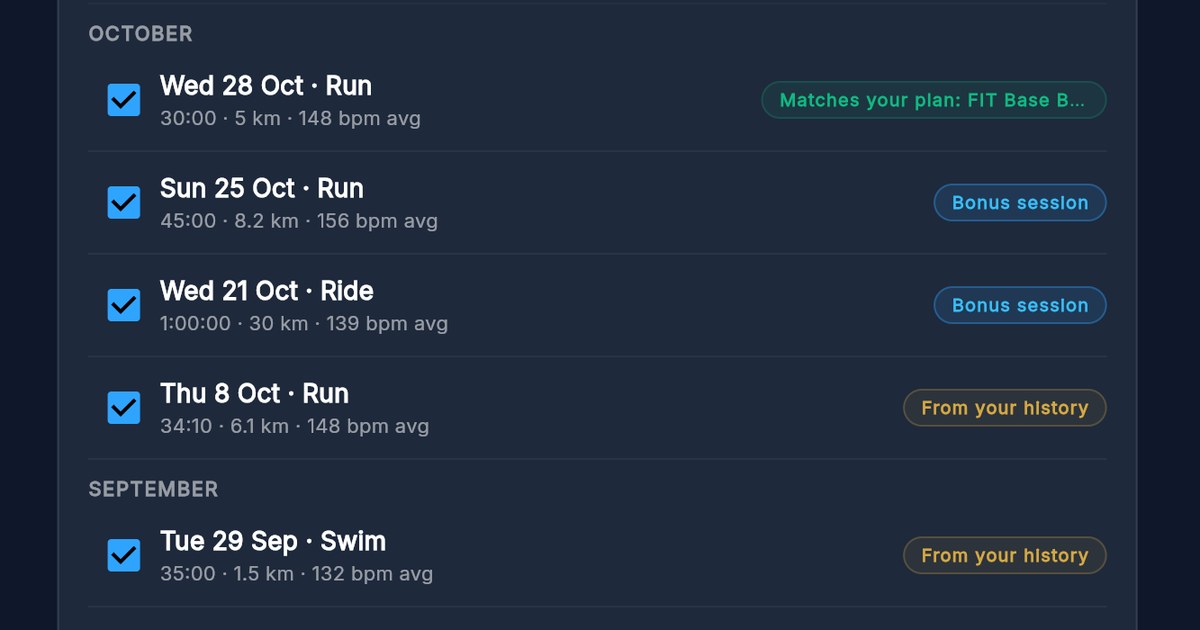
What input caused it, and is that input true? This one catches a lot. A duplicate activity from a second app, rides you forgot to log, or a fortnight of sessions rated as brutal because work was rough all look like real signals to the plan. If the input is wrong, fix the input and you’ve fixed the plan.
Does the week still add up? One session moving matters less than the shape of the week. If your long session and one quality session survive, the week is probably fine. If the plan keeps taking your key session away, that’s worth raising.
Run your own numbers: If your plan keeps easing off, use the Deload Week & Fatigue Readiness Calculator to score four multi-week signals and see whether a proper deload would serve you better than a string of small cuts.
When you disagree
You know things the model doesn’t. Maybe the bad night was the baby and your legs are fine, or this is the one session your training partner can make all month. That’s good information, and the useful move is to give it to the plan.
- Say why. “My legs are fine, I slept badly because of the baby” is far more useful than quietly doing the old session.
- Run a short test. If you’re unsure, follow the change for a week and see how the next hard session goes.
- Watch for a pattern. If the plan eases off week after week, either you’re carrying more load than you think, or its picture of you is off. A fresh benchmark usually tells you which.
- Judge the block. A single session tells you little. Over four to six weeks, look at whether your repeatable efforts are improving and how you’re recovering.
How this works in Pelaris
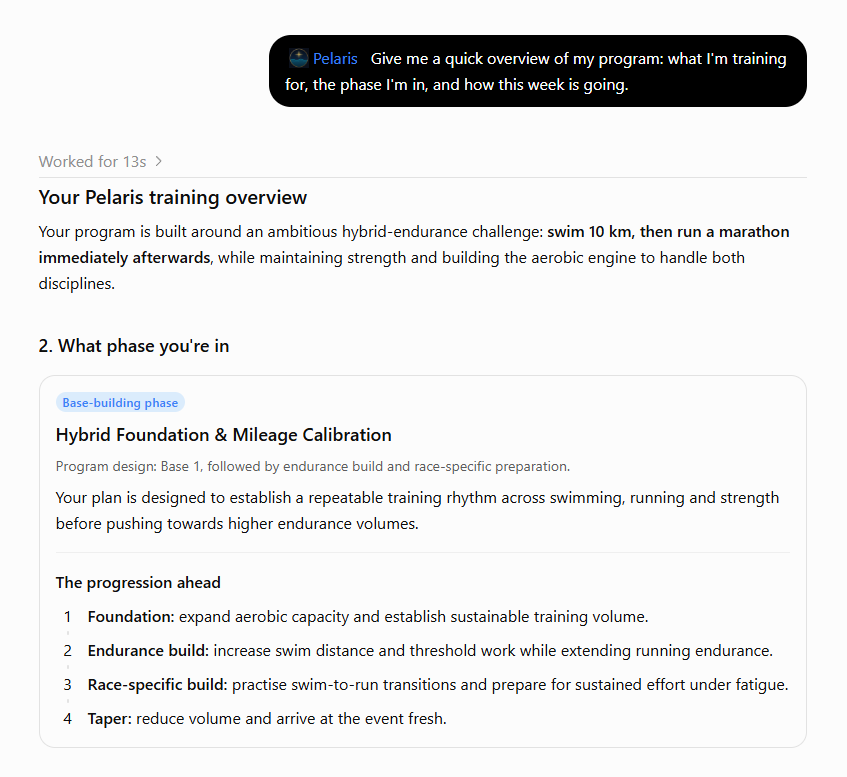
Pelaris doesn’t sweat the small stuff. One bad night’s sleep isn’t a reason to change a week of programming. One missed session or a higher than expected effort doesn’t change the program either. It adapts to your life, not to outlier signals.
When something real has changed, Pelaris builds it into your coming week without stopping to ask. I would rather the coach use its judgement and tell you what it did than send you a stack of approvals every week. When a build changes your sessions, Today usually shows a short “Adapted for you” note in the coach’s own words, with a link to the session and a way to ask the coach about it.
The week is still yours. You can change your program two ways: by hand, or by talking to the coach in the app. The coach adjusts based on your feedback and remembers it, and you can see what it has kept under What Coach Knows in your profile. On the day, “Keep it light today” sits under your session if that’s what the day calls for. If you would rather approve the changes you ask for in chat, there’s a switch called “Check with me first”.
AI coaching still gets things wrong, ours included, and it doesn’t replace a great human coach. That’s why the feedback matters so much. The features page has the wider picture, and I’ve written about how the program gets built in the first place. The goal is a coach you can read, and how a coach talks to you is a big part of that.
What this means for your training
- Expect your plan to change when your life does, not over one bad night. Look for the reason before you judge it.
- Check the input first. Wrong or missing data causes a surprising number of strange changes, and it’s the easiest thing to fix.
- Separate a dose change from a change of purpose. The second deserves an explanation.
- When you know something the plan can’t, tell it. Your reasons shape the sessions that follow.
- Judge the plan over a block of four to six weeks. Adapting to the athlete tends to help modestly and steadily, so one session won’t show it.
Trust in a coach gets built the same way with software as with a person. You see the reasoning, you push back now and then, and over a few blocks you find out whether it knows you.
Amber: Standard Volume Deload (-40% Sets)
Fatigue Score: 5 / 10
10 sets/wk
Down from 16 normal sets
3 to 4 RIR (RPE 6 to 7) · 90 kg
Hold bar @ ~90% working load
A simple checklist and a general fitness estimate, not a diagnosis. If tiredness or low mood lingers, talk to a doctor or coach.
The link carries the numbers you entered in the part of the address after the #, which is never sent to a server. Share it only with people you are happy to show those numbers to.
About these numbers: Formula, guard-rails & 4 peer-reviewed citations ▾
Standard Volume Deload = 60% Working Sets × 90% Working Load @ 3–4 RIR
During a standard deload, cut sets by about 40% before cutting bar weight, so the lifts stay familiar while fatigue clears. Meeusen et al. (2013) note that no single marker reliably separates ordinary training fatigue from overreaching, so look at trends across several signals. Fatigue, low mood or flat performance that does not lift after a week or two of easier training is worth raising with a doctor or coach.
- • No single marker reliably separates ordinary training fatigue from overreaching, so signals such as performance, sleep, mood and heart rate are read as trends across several days rather than from one hard workout. [Source]
- • More quality sets generally means more muscle, and this meta-analysis is why your weekly volume grows deliberately rather than all at once. [Source]
- • How your loads, sets and rest periods step up across a training block follows the American College of Sports Medicine's progression model for healthy adults. [Source]
- • Sleep is treated as training, and this expert consensus is why we nudge you towards your own sleep need rather than a one-size-fits-all number. [Source]
General fitness and training estimates only, labelled EST. Not medical advice or a clinical diagnosis.