Fitbod Alternative
Not just tomorrow's workout.
A program that runs for months.
The Fitbod alternative for lifters who want real periodisation, not just the next session. Pelaris builds a multi-week program with a defined arc, explains why each session sits where it does, and adapts when your data says the plan needs to bend.


Programme & Log Audit · Schoenfeld Volume Landmarks
Interactive Workout Volume & 1RM Calculator
Audit your split balance against Schoenfeld landmarks or project your one-rep max.
50 sets
Schoenfeld Target: 10-20/muscle
1.5 : 1
Target symmetry: 1.0 : 1
1.5 : 1
Posterior chain balance
- • Push-to-Pull ratio is 1.5:1. Add 6 weekly upper-back/row sets to balance shoulder mechanics.
- • Quad-to-Posterior ratio is 1.5:1. Add 3 to 4 hinge/hamstring sets (RDLs or Nordic curls).
- • One cardio session or fewer a week is unlikely to reach the WHO 150 to 300 minutes of moderate activity. If you can, add one or two easy Zone 2 sessions, ideally 6 hours away from lifting.
General fitness and training estimates only. Not medical advice.
The link carries the numbers you entered in the part of the address after the #, which is never sent to a server. Share it only with people you are happy to show those numbers to.
About these numbers: Formula, guard-rails & 3 peer-reviewed citations ▾
Target Hypertrophy Band = 10–20 Hard Sets/Muscle/Week · Optimal Push:Pull ≈ 1.0 : 1.0
All CSV parsing and volume calculations run 100% locally in your browser. Warm-up sets (RPE < 6 or > 4 RIR) should not be counted toward your 10 to 20 weekly working sets.
- • More quality sets generally means more muscle, and this meta-analysis is why your weekly volume grows deliberately rather than all at once. [Source]
- • How your loads, sets and rest periods step up across a training block follows the American College of Sports Medicine's progression model for healthy adults. [Source]
- • The weekly movement target your plan aims at, 150 to 300 minutes of moderate activity plus regular strength work, comes straight from the WHO's global guidelines. [Source]
General fitness and training estimates only, labelled EST. Not medical advice or a clinical diagnosis.
Leave this at 0 RIR and the number is plain Epley on the reps you completed, the same as the Pelaris app shows for the same set. If you stopped short of failure, choose the reps you had left and they are added to the set.
116.7 kg
Epley · 5 effective reps
94.5 kg
Strength-Hypertrophy
87.5 kg
Hypertrophy Working Load
| Reps | % 1RM | 0 RIR Max | Target @ 2 RIR | Training Zone |
|---|---|---|---|---|
| 1RM | 100% | 116.5 kg | 106 kg | Max Strength |
| 2RM | 94% | 109.5 kg | 103 kg | Max Strength |
| 3RM | 91% | 106 kg | 100 kg | Max Strength |
| 5RM | 86% | 100 kg | 94.5 kg | Strength-Hypertrophy |
| 6RM | 83% | 97 kg | 92 kg | Hypertrophy |
| 8RM | 79% | 92 kg | 87.5 kg | Hypertrophy |
| 10RM | 75% | 87.5 kg | 83.5 kg | Hypertrophy |
| 12RM | 71% | 83.5 kg | 79.5 kg | Hypertrophy |
| 15RM | 67% | 78 kg | 74.5 kg | Muscular Endurance |
General fitness and training estimates only. Not medical advice.
The link carries the numbers you entered in the part of the address after the #, which is never sent to a server. Share it only with people you are happy to show those numbers to.
About these numbers: Formula, guard-rails & 3 peer-reviewed citations ▾
1RM = Weight × (1 + Reps ÷ 30) · optional: add Reps in Reserve to Reps
Reynolds, Gordon and Robergs (2006) concluded that a one-rep max can be estimated well from multiple-repetition sets, and advised staying at or under about ten repetitions. Past that, the result is a rough guide because the set measures endurance and discomfort tolerance as much as maximal strength.
- • Your projected 1RM is read off a hard multi-rep set, and this study is the evidence that a max can be estimated well without you ever having to test one. [Source]
- • Reps in reserve is how we ask you to rate a set, a scale built so your effort on the day sets the load rather than a fixed number on paper. [Source]
- • How your loads, sets and rest periods step up across a training block follows the American College of Sports Medicine's progression model for healthy adults. [Source]
General fitness and training estimates only, labelled EST. Not medical advice or a clinical diagnosis.
Session suggestion vs real programming
Fitbod is genuinely useful. If you are new to lifting or you just want something to tell you what to do each time you open the gym app, Fitbod's session-suggestion model works. You get a workout. You log it. Next time, Fitbod picks another.
What is missing is periodisation. There is no week five that looks different from week one. No deload schedule. No taper for a meet. No build block that layers volume then intensity. The "program" is whatever the next-session algorithm decides, which means it drifts rather than progresses.
Pelaris is programming-first. A 12-week block has a defined arc, named methodology, phases, and a peak. Sessions adapt to your data, but within the arc you chose. The session suggestion loop is there, inside the program, not instead of it.
Pelaris vs Fitbod
Pricing and tier details reflect each app's published information at time of writing.
| Feature | Pelaris | Fitbod |
|---|---|---|
| Workout logging | Always free | 3 free, then paid |
| Free tracker beyond 3 sessions | No session limit | |
| AI session suggestions Tomorrow's workout suggested from history. | Plus multi-week planning | Core feature |
| Periodised programs Progression over weeks and months, not just next session. | Multi-week periodisation | Day-to-day suggestions |
| Multi-sport support | ||
| AI coach conversation | ||
| Team sport scheduling | ||
| Native apps + everywhere it runs | iOS, Android, web, and inside ChatGPT | iOS and Android |
| Pricing | Free tracking. Paid coaching. | ~$13/mo Elite |
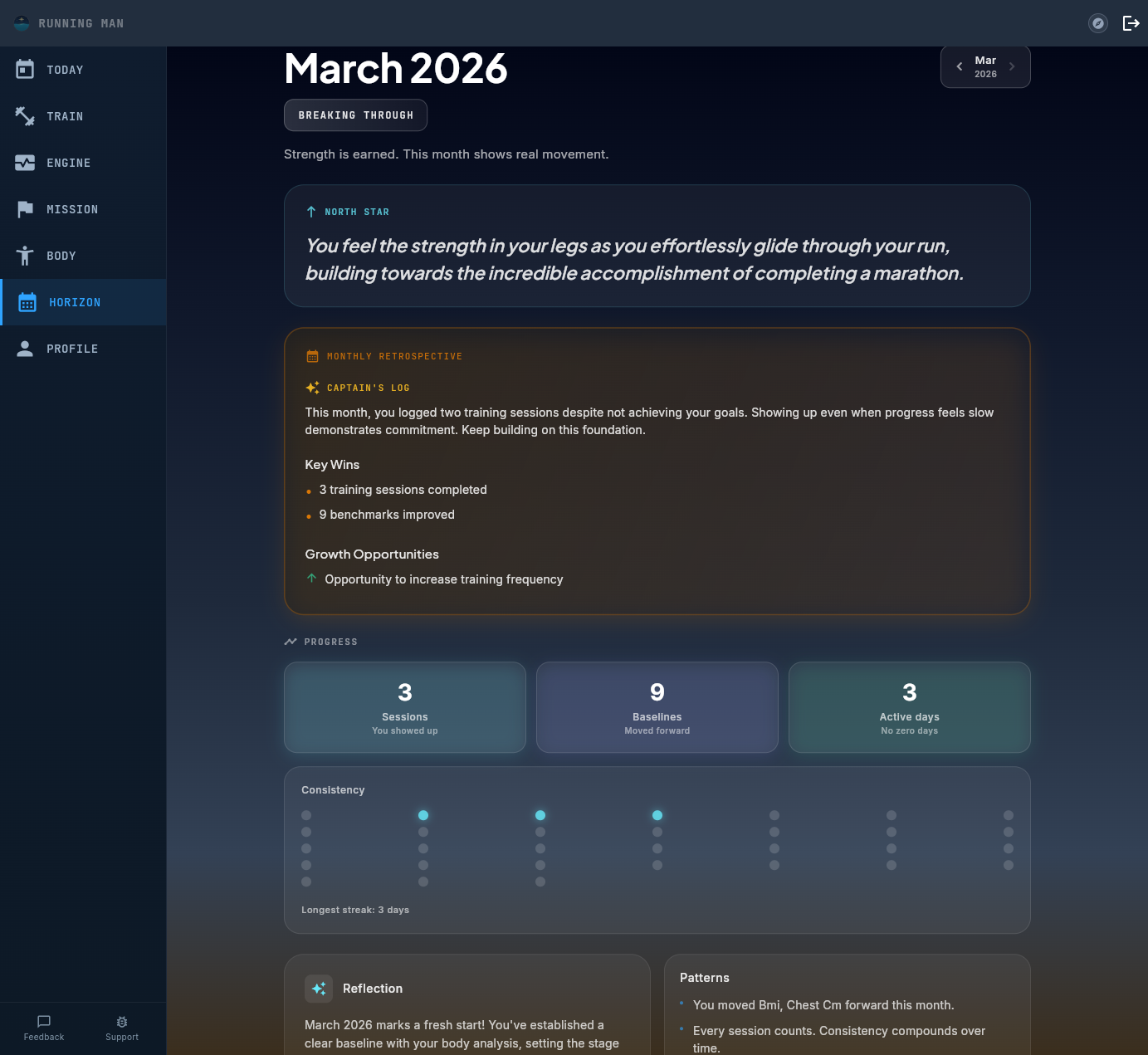
See the shape of your program
Horizon view shows the week, the block, the peak. Not just today's workout, but how today's workout relates to the goal.
Bring your history
Your Fitbod history comes with you
Export your workouts from Fitbod as a CSV, then bring the file into Pelaris under Profile, Data. Pelaris reads the columns for you and shows you what it found, the sessions and the dates they cover, before anything is saved. Your sets, reps, weights, notes and dates come across, and your PRs are rebuilt from those sets with the dates you actually set them. Importing is free.
You pick the file in the Pelaris app on your iPhone or Android phone, or in the web app in any browser, and your history then appears everywhere straight away.
Train with a watch as well? Your Garmin, COROS, Suunto, Wahoo and Polar sessions come across too, as FIT files, each on its real date. Import FIT files into Pelaris.
Switching from Fitbod, answered
What is the actual difference between Fitbod and Pelaris? +
Does Pelaris work for pure strength training like Fitbod? +
Is the Fitbod free tier enough for most people? +
Can I use Pelaris for cardio and strength together? +
How does the AI actually work? +
Does Pelaris have a mobile app? +
Try a real program instead of a daily suggestion
More alternatives