Critical Swim Speed (CSS) and SWOLF: Testing Your Threshold Pace
How to run the 400m + 200m Critical Swim Speed (CSS) test, calculate your 5 pool training zones, and avoid the classic Garmin SWOLF glide trap.
On this page (5 sections)
- What Is Critical Swim Speed (CSS) and Why Does Every Swim Coach Use It?
- How to Run the 400m + 200m CSS Test in One Pool Session
- The CSS Formula (And the 10-Second Mental Shortcut)
- SWOLF Explained: What It Measures (And How Swimmers Ruin Their Stroke Chasing It)
- Turning Your CSS and SWOLF Into Adaptive Training
- ⚡ Interactive: Swim Dryland Volume Calculator
Every week, swimmers step out of the pool, sync their Garmin or Apple Watch, and stare at two numbers: Pace per 100m and SWOLF.
In platforms like MySwimPro, Swim.com, Garmin Connect, and Pelaris, those two numbers alongside Critical Swim Speed (CSS) form the mathematical backbone of pool training. Used properly, they take the guesswork out of every interval set you swim. Used blindly, they trick you into gaming your watch with a dead, over-glided stroke that falls apart in open water.
Having spent most of my life in the pool and the ocean, I love tracking data—provided you understand what the number on your wrist actually measures. Here is our team’s guide to Critical Swim Speed (CSS), how to run the 400m + 200m test, how to set your five pool training zones, and how to use SWOLF without ruining your stroke.
What Is Critical Swim Speed (CSS) and Why Does Every Swim Coach Use It?
In cycling, you have Functional Threshold Power (FTP). In running, you have Lactate Threshold Pace (LT2). In the pool, earlobe lactate sampling is impractical, and optical wrist heart rate is noisy underwater because cold water causes vasoconstriction and water rushes under the sensor on every catch.
In the early 1990s, Wakayoshi et al. (1992) and Bruce Ginn introduced Critical Swim Speed (CSS) as a non-invasive field test. Plotting two maximal middle-distance efforts—a 400-metre time trial and a 200-metre time trial—calculates the slope of your aerobic capacity without a single needle prick.
Why a 400m and a 200m instead of a single 1,500m time trial?
- Lower pacing distortion: A 1,500m time trial takes a heavy mental and physical toll and is easily skewed by pacing errors in the first 300 metres.
- True drop-off curve calibration: Comparing your 200m speed against your 400m speed reveals your fatigue decay. A sprinter who blasts a fast 200m but fades on the 400m needs a more conservative threshold target than a diesel marathon swimmer whose 200m and 400m paces sit only 3 seconds per 100m apart.
How to Run the 400m + 200m CSS Test in One Pool Session
Complete the full CSS test in a 45-minute session under consistent conditions every 6 to 8 weeks: same pool length (25m or 50m), no fins, paddles, or pull buoy, and a push start off the wall rather than a dive.
The Step-by-Step CSS Test Protocol (1,600m Total)
- Warm-Up (400m–500m): Swim 300m easy freestyle (Z1–Z2), then 4 × 50m on 20s rest (25m drill / 25m build to fast pace). Rest 2 minutes at the wall.
- Time Trial 1 — 400m Maximal Effort: Push off the wall and swim 400 metres as fast and evenly as you can sustain. Pace the first 100m at a controlled 8.5/10 effort so you do not blow up at 250m, then empty the tank over the final 100m. Record your time in minutes and seconds (T400).
- Active Recovery (5 to 8 Minutes): Swim 100m–200m easy flush, then rest at the wall until your breathing and heart rate feel completely recovered. Never start the 200m tired.
- Time Trial 2 — 200m Maximal Effort: Push off the wall and swim 200 metres for best time. Record your time (T200).
- Cool-Down (200m–300m): Swim 200m–300m easy choice of stroke.
The CSS Formula (And the 10-Second Mental Shortcut)
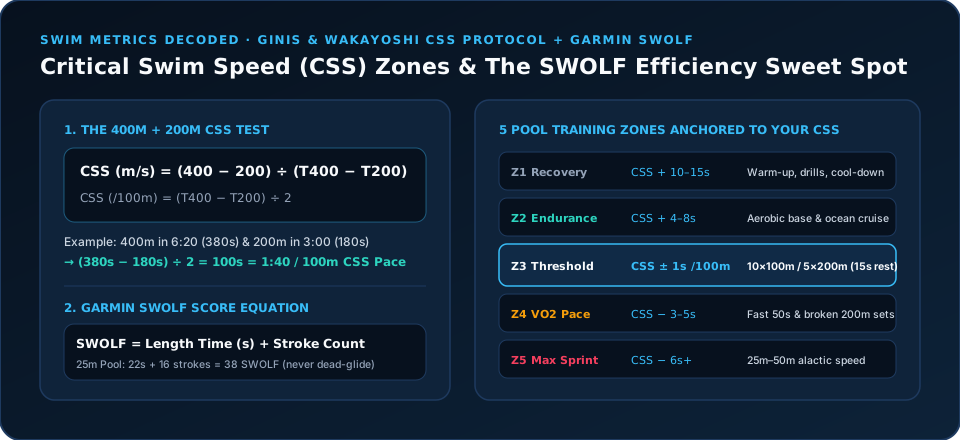
In the sport-science literature, Critical Swim Speed in metres per second (m/s) is distance difference divided by time difference:
$$\text{CSS (m/s)} = \frac{400 - 200}{T_{400} - T_{200}} = \frac{200}{T_{400} - T_{200}}$$
Because swimmers read pace clocks in seconds per 100 metres, use this arithmetic shortcut:
$$\text{CSS Pace (seconds per 100m)} = \frac{T_{400\text{ (in seconds)}} - T_{200\text{ (in seconds)}}}{2}$$
Worked Example
Suppose you swim 400m in 6:20 (380 seconds) and 200m in 3:00 (180 seconds):
- Subtract T200 from T400: 380 - 180 = 200 seconds.
- Divide by 2: 200 / 2 = 100 seconds per 100m.
- Convert to minutes and seconds: 1:40 / 100m is your Critical Swim Speed.
Your five pool training zones then lock into place:
| Swim Zone | Name | Target Pace (per 100m) | Example @ 1:40 CSS | Typical Interval Set |
|---|---|---|---|---|
| Zone 1 | Recovery & Technique | CSS + 10s to +15s | 1:50 – 1:55 /100m | Warm-up, sculling drills, cool-down |
| Zone 2 | Aerobic Endurance | CSS + 4s to +8s | 1:44 – 1:48 /100m | Continuous 800s, open-water cruise sets |
| Zone 3 | CSS Threshold | CSS ± 1s | 1:39 – 1:41 /100m | 10 × 100m or 5 × 200m (10s–20s rest) |
| Zone 4 | VO2max / Race Overload | CSS - 2s to -5s | 1:35 – 1:38 /100m | 8 × 50m or broken 200s (20s–30s rest) |
| Zone 5 | Neuromuscular Sprint | CSS - 6s+ (Max) | < 1:34 /100m | 6 × 25m all-out (45s–60s rest) |
SWOLF Explained: What It Measures (And How Swimmers Ruin Their Stroke Chasing It)
SWOLF (Swim + Golf) adds your time and stroke count for a single pool length:
$$\text{SWOLF} = \text{Time per Length (seconds)} + \text{Strokes per Length}$$
Swim a 25m length in 22 seconds taking 16 strokes, and your SWOLF score is 22 + 16 = 38.
Why You Cannot Compare 25m SWOLF to 50m SWOLF
Only compare SWOLF against yourself in the same pool length:
- In a 25m short-course pool: Every length starts with a wall push-off and streamline glide covering 5 to 7 metres for free.
- In a 50m Olympic pool: Half as many push-offs and double the length means a swimmer logging 38 in a 25m pool typically logs 78–84 in a 50m pool.
The Classic Garmin Dead Glide Trap
“Decelerating and re-accelerating your body mass on every stroke just to lower your Garmin SWOLF score wastes massive energy, drops your hips, and gets you destroyed the moment you hit open-water chop.”
Because SWOLF weights seconds and strokes equally, many swimmers game their count by kicking off the wall, taking a stroke, and gliding for two seconds until they nearly stop:
- Stroke count drops: From 18 to 12.
- Time per length slows: From 23s to 26s.
- SWOLF drops: From 41 to 38—and the watch congratulates them.
As our team broke down in why triathletes get swim stroke efficiency backwards, true efficiency comes from propelling force per stroke: fingers together, clean entry, early vertical forearm catch, and continuous turnover (58 to 72 strokes per minute) without dead spots.
How to Use SWOLF Properly
“Lock in your target pace on the clock first, then use SWOLF as a fatigue detector—when your split stays at 25 seconds per length but your stroke count creeps from 16 to 19, your catch is slipping.”
- Lock in target pace first: Hold a fixed split such as 25s per 25m during a CSS threshold set.
- Track stroke stability across reps: Watch whether your stroke count and SWOLF stay steady from Rep 1 (25s + 16 = 41) to Rep 10.
- Spot mechanical fatigue early: If your split stays at 25s on Reps 8–10 while strokes creep from 16 to 19 (SWOLF 44), your lats are fatiguing and your catch is slipping.
Turning Your CSS and SWOLF Into Adaptive Training
Testing CSS every 6 to 8 weeks takes 45 minutes and transforms every pool session in between. Instead of guessing whether 10 × 100m felt hard enough, you know the exact split on the clock and when to push your structured pool intervals to your Garmin watch.
3 / week
4 working sets / lift
1 : 1 Ratio
External rotation balance
≥ 24 Hours
Lat pull-down power, scapular upward rotation & streamlined core tension
General fitness and training estimates only. Not medical advice.
The link carries the numbers you entered in the part of the address after the #, which is never sent to a server. Share it only with people you are happy to show those numbers to.
About these numbers: Formula, guard-rails & 3 peer-reviewed citations ▾
Pool > 35km/wk = 2 Dryland Sessions · Pull : External Rotation = 1 : 1 · Sprint Buffer ≥ 24h
High-volume swimmers accumulate thousands of internal-rotation shoulder strokes per week. Every heavy vertical pull set in the gym should be paired 1:1 with scapular upward rotation and external rotation work.
- • When strength and endurance share a week we space and shape them using this meta-analysis, so one goal never quietly eats the other. [Source]
- • How your loads, sets and rest periods step up across a training block follows the American College of Sports Medicine's progression model for healthy adults. [Source]
- • More quality sets generally means more muscle, and this meta-analysis is why your weekly volume grows deliberately rather than all at once. [Source]
General fitness and training estimates only, labelled EST. Not medical advice or a clinical diagnosis.