Best Body Scan Tools Compared: DEXA, InBody, 3D & Photo AI
An athlete's comparison of clinical DEXA, InBody 570/770/970, Styku & Fit3D 3D booths, Garmin & Withings smart scales, and Pelaris AI body scanning.
On this page (4 sections)
Every body composition tool solves a three-way trade-off between clinical precision, cost per scan, and whether you will still do it under identical conditions six months from now.
A method accurate to a fraction of a kilogram in a radiology clinic only helps if you book it. A Wi-Fi bathroom scale is effortless, right up until a salty dinner or a night on the beers shifts your electrical impedance by three percentage points overnight. And a standalone scanner that never talks to your training log can tell you that your waist or lean mass changed, but has no idea whether that happened during a heavy 5/3/1 lifting block or a marathon taper.
Earlier in the year our team looked at the underlying physics in our method-by-method overview of DEXA, bioimpedance, 3D scanners and photo analysis. Here, we compare the clinical standards, commercial gym hardware, and connected ecosystems that athletes weigh up today: Clinical DEXA, InBody clinic analysers, 3D infrared booths (Styku and Fit3D), smart scales (Garmin Index S2, Withings Body Scan, and Whoop), and Pelaris AI Body Scanning.
The five premium tiers of body composition tracking
Rather than ranking a single winner when each category uses different physics, evaluate each tool by the job it was built to do.
1. Clinical DEXA ($100–$250 per scan): the periodic lab anchor
To know your regional lean mass and fat mass down to the gram, nothing touches a clinical DEXA scan. Passing two low-dose X-ray beams through your body, a GE Lunar or Hologic scanner separates fat mass, lean soft tissue, and bone mineral content across each arm, leg, and the trunk.
- Clinical gold standard: Provides Appendicular Lean Mass Index (ALMI) and left-versus-right limb muscle symmetry when returning from a knee, hamstring, or shoulder injury.
- Cost and friction: At $100 to $250 out of pocket plus a fasted clinic visit, nobody runs a DEXA every fortnight.
- Inter-machine variance: As Ramirez and colleagues (2026) showed across three DXA machines in 99 adults, group averages differed by up to 2 percentage points (34.4% to 36.4%) between hardware models. Always return to the same clinic machine.
- Best used as: Your once- or twice-a-year benchmark anchor at pre-season or the end of a major block.
2. Commercial Multi-Frequency BIA: InBody 570 / 770 / 970 & Evolt 360 ($30–$90 per scan)
Commercial analysers like the InBody 570, 770, 970, or Evolt 360 use 8-point tactile electrodes on thumbs, palms, heels, and forefeet, sending multi-frequency currents through five body cylinders.
- Fast segmental breakdown: Takes under 60 seconds and prints Skeletal Muscle Mass (SMM), segmental lean balance, and intracellular versus extracellular water, which we walk through in our guide to reading InBody results.
- Systematic offset vs DEXA: In Potter and colleagues’ (2022) study of 795 US Marines, the InBody 770 underestimated body fat by an average of 3.4 percentage points compared with DEXA (MAE 3.9 points).
- Sensitivity to water shifts: Drinking water beforehand, testing after evening training, or testing the morning after a big night on the beers can swing reported body fat by 1.5 to 3 percentage points without a gram of real fat changing.
- Best used as: A monthly or 8-week gym checkpoint under identical fasted morning conditions on the same machine. (Pelaris is not affiliated with InBody or Evolt.)
3. 3D Optical & Infrared Turntable Booths: Styku & Fit3D ($40–$80 per scan)
In optical booth scanners like Styku or Fit3D, you stand on a turntable for 35 seconds while infrared depth sensors capture a 360-degree surface mesh and circumferences.
- Repeatable surface girths: Validation work by Bourgeois and colleagues (2017) and Tinsley and colleagues (2020) confirmed reliable circumference and volume tracking across training interventions.
- Tied to studio hardware: Your scan history is locked to that physical studio, and optical cameras read external shape rather than internal tissue density.
- Best used as: A monthly circumference and 3D shape tracker if your club membership includes a booth.
4. Tier-1 Smart Scales: Garmin Index S2, Withings Body Scan & Whoop ($250–$650 hardware)
Step onto a Garmin Index S2 and your morning weight and foot-to-foot BIA sync straight to Garmin Connect and Whoop; step onto a Withings Body Scan and a retractable handle adds 8-electrode segmental BIA at home.
- Zero daily friction: Bathroom-floor convenience drives high 12-month compliance, and the Withings handle avoids skipping the torso.
- Hydration noise and training isolation: Home BIA still swings with sweat and sodium, and scales record weight without adapting your lifting sets, runs, or swim volume.
- Best used as: Automated morning weight and 7-day rolling averages paired with a coaching platform.
5. Pelaris AI Body Scan + Lab Sheet Hub (Free first scan; included in Pelaris plans)
“Athletes do not need another isolated machine pretending to be a DEXA scanner. They need a way to anchor their occasional lab numbers and track their shape, proportions, and training week in one place.”
Our team built Pelaris Body Scanning to connect visual check-ins, lab sheets, and training load:
- Two photos, anywhere, in 60 seconds: Take a front and side photo on your phone. Pelaris estimates shoulder, waist, and hip proportions, maps your frame to six archetypes (such as the V-Taper build), and draws a rotatable 3D Body Blueprint across your timeline.
- An honest body fat range, never a fake decimal: As explained in our guide to photo body fat accuracy and why ranges win, 2D photo studies (Encarnação et al., 2026) show strong repeatability (ICC 0.98–0.99) alongside an individual spread against DEXA. Instead of inventing a fake single decimal like 14.7%, Pelaris shows an error-tolerance range that tightens over time.
- Upload your DEXA, InBody, or scale results: Upload any lab PDF, screenshot, or photo into Pelaris so your measured lab result anchors your photo check-ins.
- Connected directly to your adaptive coach: Your scan lives next to your 5/3/1 lifting log, Garmin runs, and pool swims so your training plan and body recomposition goals work together.
Head-to-head comparison matrix
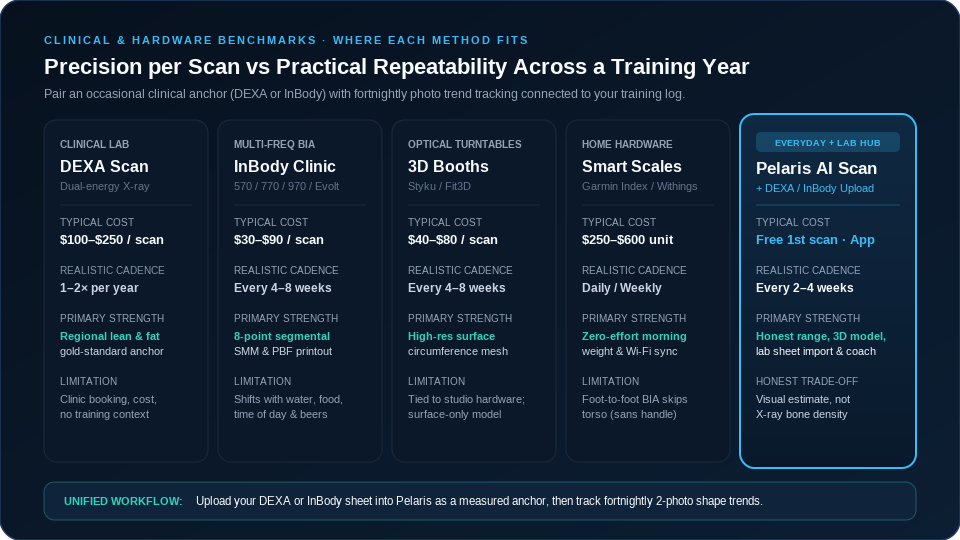
| Method / Platform | Physics | Typical Cost (AU) | Realistic Cadence | What It Does Best | Key Trade-Off |
|---|---|---|---|---|---|
| Clinical DEXA (GE Lunar / Hologic) | Dual-energy X-ray absorptiometry | $100–$250 / scan | 1–2× per year | Gold-standard regional fat, lean mass (ALMI) & limb symmetry | Clinic booking, out-of-pocket cost, no training log integration |
| InBody 570 / 770 / 970 & Evolt 360 | 8-point multi-frequency BIA | $30–$90 / scan (or club perk) | Every 4–8 weeks | Fast segmental Skeletal Muscle Mass (SMM) & ECW/TBW printout | Swings 1.5–3% with water intake, time of day, or a night on the beers |
| Styku / Fit3D Booth | 3D infrared turntable camera | $40–$80 / scan (or studio tier) | Every 4–8 weeks | High-resolution 360° circumference & volume mesh | Locked to a physical studio; surface geometry only |
| Garmin Index S2 / Withings Body Scan | Home Wi-Fi BIA (foot or handle) | $250–$650 hardware | Daily / Weekly | Effortless morning weight & ecosystem sync (Garmin / Whoop) | Foot-only scales skip the torso; sensitive to hydration noise |
| Pelaris AI Scan + Lab Result Upload | 2-photo computer vision + OCR lab sheet import | Free 1st scan · Pelaris plans | Every 2–4 weeks (+ lab anchors) | Honest range, 3D Body Blueprint, DEXA/InBody import & adaptive coaching | Visual estimate (not X-ray bone density); requires consistent photo light |
How to combine them: the two-speed stack that works
“Book a fasted DEXA or InBody scan once or twice a year to lock in your lab baseline, then use a 60-second two-photo scan every fortnight for the 50 training weeks in between.”
The smartest setup is a two-speed stack:
- Slow, high-precision anchor (every 6 to 12 months): Book a fasted DEXA scan or InBody scan once or twice a year and upload the sheet into Pelaris.
- Fast, zero-friction trend (every 2 to 4 weeks): Take a 60-second two-photo check-in in Pelaris under consistent morning light (and check your waist with the RFM calculator above) to watch your proportions and 3D Body Blueprint move alongside your training.
What this means for your training
- Match the tool to the cadence: Use DEXA once or twice a year for regional lean mass, and a fortnightly check-in for the 50 weeks in between.
- Never compare raw numbers across different hardware: Follow the trend within each method rather than mixing physics with a 3.5-point offset.
- Anchor your photo scans with your lab sheets: Upload any DEXA, InBody, or scale printout into Pelaris so measured numbers lead.
- Connect your body trend to your training load: House your scans and adaptive training plan in the same place.
0.45
Below 0.50 (the usual guide)
0.83
Below WHO 0.9 cut-off
24.6
18.5 to 24.9 (WHO adult range)
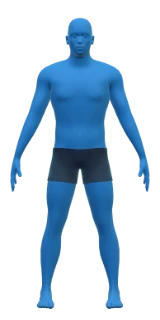 3D Blueprint
 Outline
V-Taper Build
Broad shoulders over a narrow waist, the classic athletic taper.
Broad shoulder-to-waist ratio driven by upper-back, lat and deltoid width. Common in: Swimmers, gymnasts, rugby backs.
All 6 Pelaris Body Shape Archetypes
Compare how Pelaris maps proportions across all six builds. Switch Male / Female above to see both 3D Blueprint models.
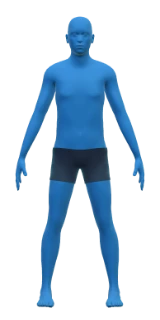
A streamlined endurance build that carries speed and distance with ease.
Runners, distance swimmers, triathletes
Broad shoulders over a narrow waist, the classic athletic taper.
Swimmers, gymnasts, rugby backs
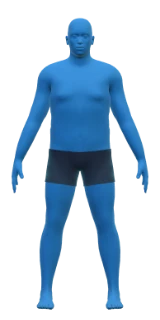
A powerful, solid frame built for moving heavy loads.
Powerlifters, strongmen, rugby forwards
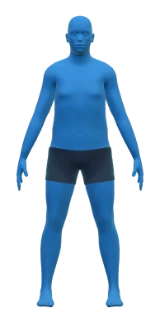
A strong lower-body engine with power through the hips and legs.
Track cyclists, sprinters, rowers
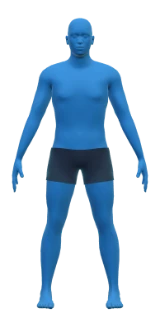
Balanced shoulders and hips around a defined waist, ready for any training style.
Functional fitness, hybrid athletes
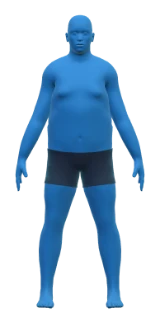
A sturdy frame with strength through the core, ready for any training style.
Heavyweight lifters, athletes in a rebuilding phase
For adults aged 18 and over. A general fitness estimate, not a medical assessment or diagnosis.
The link carries the numbers you entered in the part of the address after the #, which is never sent to a server. Share it only with people you are happy to show those numbers to.
About these numbers: Formula, guard-rails & 3 peer-reviewed citations ▾
WHtR = Waist ÷ Height (< 0.50) · WHR = Waist ÷ Hips · BMI = kg ÷ m²
A higher BMI with a Waist-to-Height Ratio below 0.50 can reflect muscle rather than central body fat. These adult cut-offs are for people aged 18 and over. The archetype is a quick tape-measure guess: the Body Scan reads your shape from photos and can land somewhere different. Tape ratios are general fitness estimates, never a medical assessment or diagnosis, and a doctor is the right person to ask about your health.
- • Waist-to-height ratio earns its place on your card, this review of 31 studies found it a sharper screening signal than BMI or waist alone. [Source]
- • Your waist-to-hip ratio is read against the World Health Organization's expert consultation, the global reference for what waist measurements genuinely tell us. [Source]
- • We show BMI exactly as the World Health Organization defines it, using the same adult cut-offs public health uses worldwide. [Source]
General fitness and training estimates only, labelled EST. Not medical advice or a clinical diagnosis.