PR Tracker
Your PR tracker,
already keeping score.
Pelaris is a free PR tracker with automatic personal record detection. Log your sets the way you normally would and every new estimated one-rep max and every new best at a given rep count is picked up as it happens. Warm-ups excluded, no spreadsheet, no trying to remember whether that set of five was actually a record.
Records follow you everywhere. Pelaris is on iOS and Android, on the web, and inside ChatGPT.


The four kinds
What actually counts as a PR
“PR” gets used as one word for four different things, which is why people end up unsure whether they hit one. They are genuinely different measurements, and knowing which is which changes how often you should expect to break one. Rep-max PRs move most weeks. Tested singles move a few times a year.
A tested one-rep max
The classic. You load the bar, you lift it once, and that number is real rather than inferred. It is the most honest measure of maximal strength and the most expensive one, because a true single is taxing to attempt and needs a day where you are fresh. Most people should test rarely and train often.
A rep-max PR
The best weight you have ever moved at an exact rep count. Your 5RM, your 3RM, your 8RM. These are the records that actually move week to week, because you hit those rep ranges constantly. A new 5RM on squats is a real personal record even if your tested single has not budged in a year.
An estimated one-rep max
A projection of your single, calculated from a hard multi-rep set. Do 100kg for 5 and the maths says roughly 117kg for 1. It lets every working set report on your maximal strength without you ever stepping under a true single. The trade-off is accuracy, which is covered further down this page.
A volume PR
Total work done, weight multiplied by reps, across an exercise or a session. Volume is the driver behind most hypertrophy progress, so plenty of lifters chase it deliberately. Pelaris accumulates volume in your exercise history rather than flagging it as a record, so it is there to read even though it is not one of the two PRs we surface live.
The practical takeaway: chase rep-max PRs, let the estimate track your ceiling, and test a true single only when you have a reason to. That is progressive overload doing its job, one small increment at a time.
Automatic detection
You log the set. The record looks after itself.
Most people who say they track PRs are really keeping a spreadsheet, a note on their phone, and a rough memory of what they did last block. Pelaris does the bookkeeping instead. There is nothing to mark as a PR, no separate records screen to maintain, and no monthly tidy-up.
Detected as you log
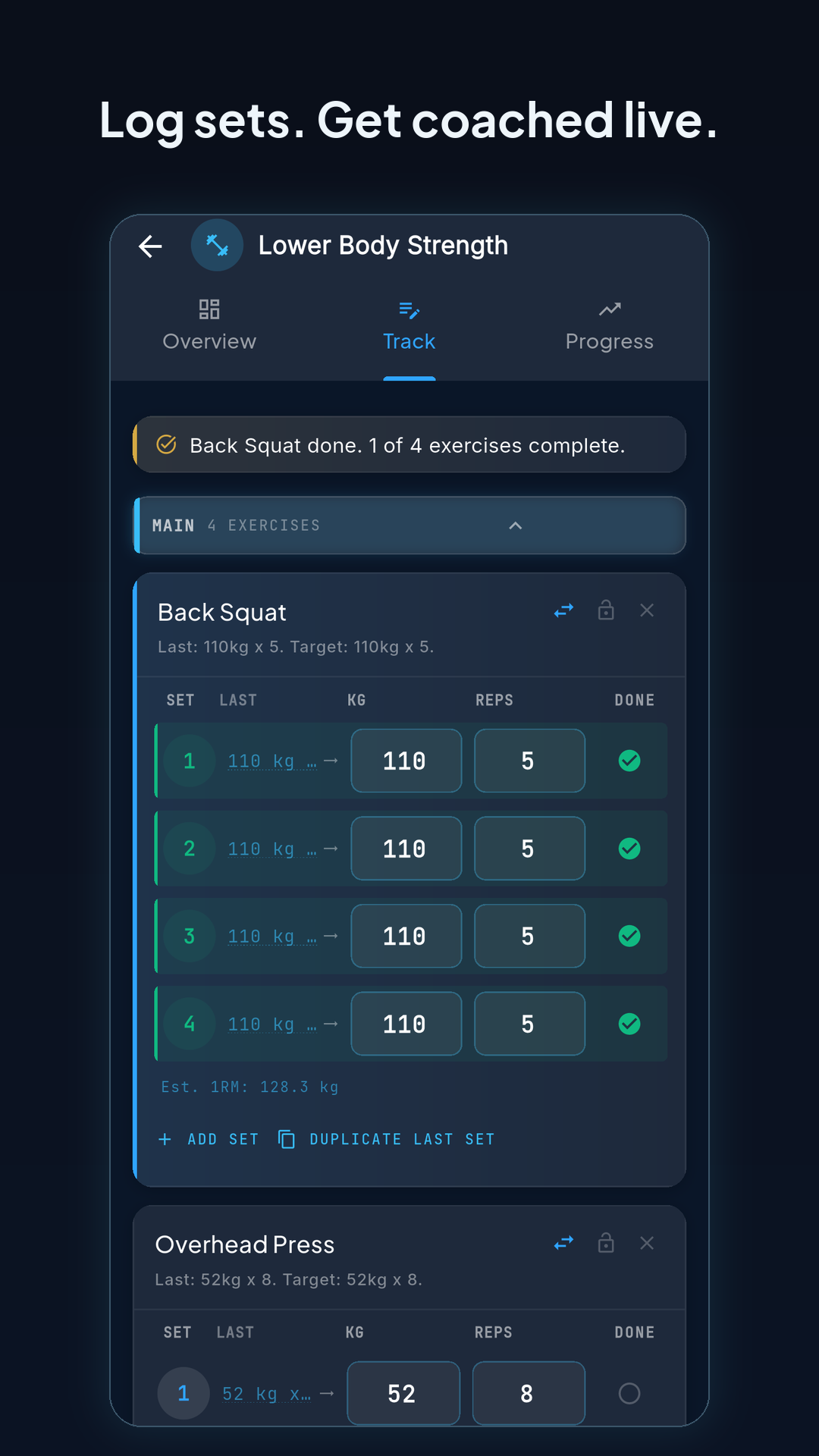
Every completed strength set is checked against your history the moment you record it, not overnight and not in a weekly summary. If the set is a record, you find out while you are still standing next to the bar, which is the only time it really feels like anything.
Two record types per exercise
A new estimated one-rep max, and a new best weight at that exact rep count. Every exercise keeps its own list, so your best at 1, at 3, at 5, at 8 and beyond all sit together and you can see which rep ranges are moving and which have gone quiet.
Honest records only
Warm-up sets are excluded from detection and from volume totals. A dominance check stops a lighter set later in the session from claiming a record when a heavier set at more reps already covered that ground. A PR you did not earn is worse than no PR at all.
A history that keeps itself
When the session finishes, your records, estimated one-rep max, and one-rep max history are written up for every exercise you touched. Months later that history is a line you can read rather than a folder of sessions you would have to add up by hand.
Every logging format
Straight sets, supersets, circuits, and drop sets all log natively, and the sets inside them are treated as sets rather than squeezed into a shape they do not fit. The workout tracker covers the logging side in full.
On whichever device is nearest
Log on your phone at the rack, read the history on a laptop that evening. Same account, same records, syncing both ways. Getting the apps takes about a minute if you already have an account.
This is the whole workflow
Weight in, reps in, set done. Everything on this page happens off the back of that, without a second step.
Benchmarks and baselines
Start with numbers, not a blank page
A brand new tracker knows nothing about you, which makes the first fortnight feel like paperwork. Benchmarks fix that. Type in the numbers you already know, your best bench, your 5k, your max pull-ups, and you have a starting line on day one instead of week three.
More than seventy to choose from
Four categories. Strength, the loaded one-rep maxes such as bench, squat, deadlift and power clean. Endurance, the time trials and tests from a 5k or a mile through to a 2k row, an FTP test, or a benchmark workout. Skill, the bodyweight and athletic maxes like pull-ups, push-ups, vertical jump, and plank hold. Body, the measurements you may already track.
Seed them, then forget them
Enter what you know during setup or add one whenever you feel like it. After that they largely maintain themselves. Beat a benchmark in a session and the new number is picked up from your training, tagged as tested or estimated and dated, and only ever replaced when you actually improve on it.
They tell the coach where to start
This is the part that matters most. Benchmarks are what the AI coach calibrates against when it prescribes loads, paces, and power targets, so a program written for someone benching 60kg is not the same program as one written for someone benching 120kg. Guessing is what produces generic plans.
Records and benchmarks are two views of the same thing. Records are what your logged sets prove, benchmarks are the headline numbers you and the coach steer by. Together they are what turns a log into a training history. The features page shows where they sit in the rest of the app, and if you also run, swim, or ride, concurrent training explains how the strength and endurance sides are kept from fighting each other.
The estimate, explained
How a set of five becomes a one-rep max
An estimated one-rep max, often written e1RM, is a projection of the heaviest single you could lift today, worked out from a set you already did. Pelaris uses the Epley formula: the weight, multiplied by one plus the reps divided by thirty. Put 100kg up for 5 and it projects about 117kg. Lift a single and the formula returns the weight you lifted, because at one rep the estimate and the result are the same number.
The reason this is worth doing is that it makes every hard working set report on your maximal strength. You do not have to schedule a test week, find a spotter, or spend a session grinding singles to know whether the last block moved anything. Your five-rep work already told you.
Now the honest limits. Every rep-max formula loses accuracy as the reps climb. In a well-cited study of seventy men and women, Reynolds, Gordon and Robergs found that 1RM can be predicted accurately from multiple-repetition testing, with the five-rep data producing the best predictions and accuracy falling away across the ten and twenty-rep conditions. Their guidance is to stay at or under about ten reps. That matches how it feels in the gym: a projection off a hard triple or a hard set of five is a solid working number, while one read off a set of twenty is measuring your tolerance for discomfort as much as your strength.
So Pelaris labels the difference rather than blurring it. Every projection is stored as an estimate with the method recorded against it, and a single you genuinely lifted is stored as a tested result. A calculated number is never quietly promoted into an achievement. If you want the full reasoning, including how the same idea is applied to race-time projections across distances, it is written up on strength and race projections.
Questions
PR tracking, answered
Is the PR tracker free? +
Do my old workouts count towards my PRs? +
Which lifts get PRs? +
What is the difference between an estimated and a tested 1RM? +
Do warm-up sets create false PRs? +
Your next PR is already on its way
Log one session and the tracking starts. Seed a benchmark or two and it starts with context. No credit card, no session cap, and PR tracking that is free for good.
Or track from your phone. Pelaris is on iOS and Android, and inside ChatGPT.